
Have you felt an attachment to animals all your life? Is helping the lives of animals something you’ve thought about doing? Then studying a Bachelor of Veterinary Biology and Doctor of Veterinary Medicine at Sydney Uni is one of the ways that you can turn your passion into a career!
This article goes what you’ll need to know before applying for a BVB/DVM — let’s dive in!
What is a Bachelor of Veterinary Biology and Doctor of Veterinary Medicine at Sydney Uni?
Core Units for this Degree
How to Get into Veterinary Biology at Sydney Uni
What’s the Teaching Format?
What’s the Faculty and Culture Like?
What is a Bachelor of Veterinary Biology and Doctor of Veterinary Medicine at Sydney Uni?
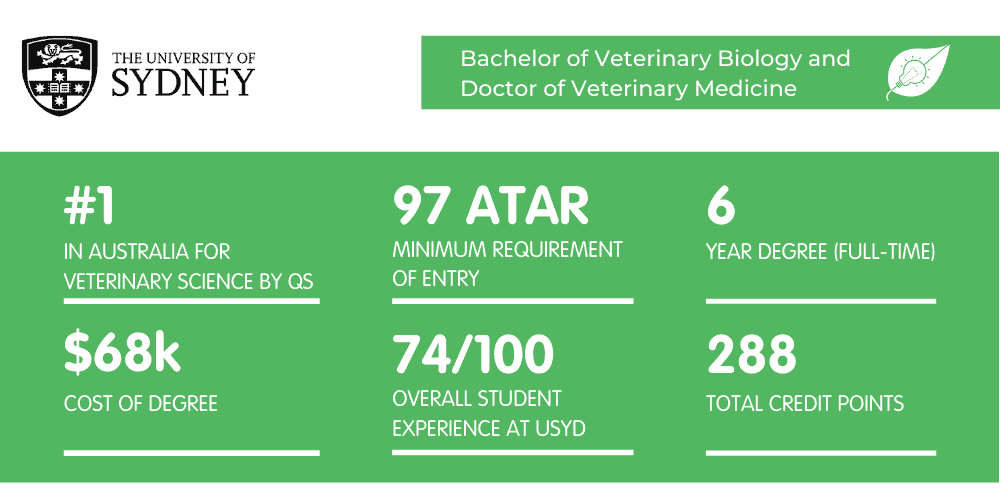
ABachelor of Veterinary Biology and Doctor of Veterinary Medicineis a course that provides the scientific knowledge, practical and research skills to enter a veterinary profession. Upon graduation, students canregister to practise veterinary medicine within Australia, the United Kingdom and South Africa!
Theoretical teaching mostly takes place on theCamperdown campuswhile practical skills such as animal handling are learned on theCamden campus.
TheBachelor of Veterinary Biology precedes the Doctor of Veterinary Medicine and must be studied togetherto have professional accreditation from the Veterinary Surgeons’ Board.
Career Paths
There arevarious career pathways for graduatesin a Bachelor of Veterinary Biology and Doctor of Veterinary Medicine at USyd. The most common arePrivate Veterinarian and Corporate Veterinarians.然而,other fields of work include:
-
- 动物al welfare
- Biosecurity
- Wildlife Conservation
- Infectious Disease Units
- Public Policy
Core Units for this Degree
Every unit in a Bachelor of Veterinary Biology and Doctor of Veterinary Medicine at USyd is a core unit,and there areno majorsin this course.
在两年的本科阶段,核心units of a Bachelor of Veterinary Biology focus primarily onbiology, chemistry and statistics, and less on animal handling. Some of the core units include:
In a Doctor of Veterinary Medicine, the core units focus onnavigating veterinary professional life, practical skills, research and enquiry, and other theory on veterinary science. These units include:
The two Foundations of Veterinary Science units and two Principles of Animal Disease have a high weighting of12 credit points each.
In the Foundations of Veterinary Science units, students learn thebody systems and anatomical, physiological and histological knowledgeof domestic animals, as well aspreventative and therapeutic treatments.
The Principles of Animal Disease units investigatedisease and the manifestation of disease in the body systems of domestic animals, production animals and wildlife.
Placements
There arenine placementsto complete during a Doctor of Veterinary Medicine! These includepractical, preclinical and preparatory clinical placementssuch as working in the Horse and Dairy Cattle industry, in the university veterinary hospital as well as commercial partner practices.
How to Get into Veterinary Biology at Sydney Uni
The ATAR cut-off for a Bachelor of Veterinary Biology and Doctor of Veterinary Medicine at USyd is97and applicantsmust complete a statement of commitment to veterinary science.
Assumed Knowledge
The assumed knowledge for the course isMathematics Advanced, Chemistry and Physics. If you haven’t taken these subjects, just keep in mind that content will be delivered in the sense that all students have this prior knowledge.Biology is also a recommended subject.
Alternate Pathways
There are other entry pathways other than meeting the ATAR cut-off!
Graduate studentscan study a Doctor of Veterinary Medicine at USydif they have successfully completed one semester of study in general chemistry (physical and inorganic), biology, biochemistry and organic chemistry at a Bachelor’s degree level.
Since entry to the course is highly competitive,graduate applicants should have also achieved a strong Grade Point Average(minimum credit average).
Scholarships
A Bachelor of Veterinary Biology and Doctor of Veterinary Medicine at Sydney Uni hasquite a hefty course fee because of the length of the course. So, looking and applying for scholarships can relieve some of these fees for eligible students!
TheDr John Holt Scholarship for Animal Welfareis a scholarshipoffered for first-year Doctor of Veterinary Medicine students and is valued at $6000 p.a. for four years.
For regional or rural students, theDalara Foundation Scholarshipcan be especially helpful as it has a value of$50000 p.a. for the entire duration of the undergraduate and postgraduate course!
What’s the Teaching Format?
In a Bachelor of Veterinary Biology and Doctor of Veterinary Medicine at Sydney Uni, classes are taught in a combination oflectures, tutorials and practicals, and in semesters.
Class Structure
Lectures
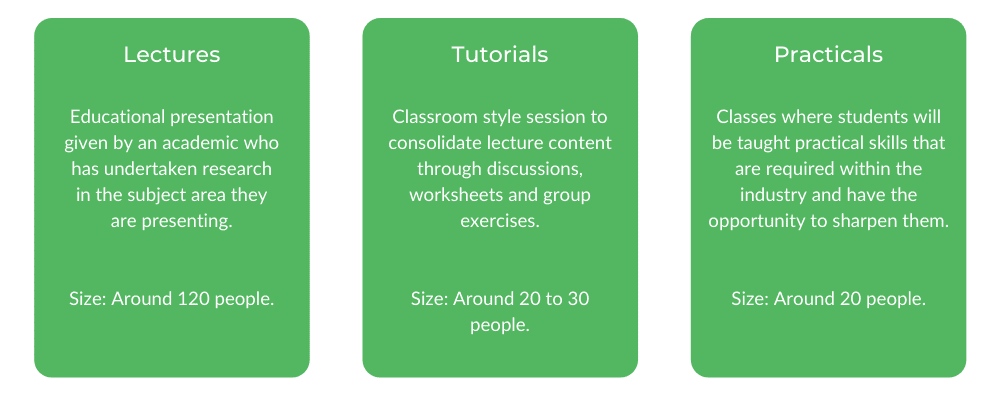
The lectures are the length of a standard time slot in USYD, which isabout 50 minutes each lecture. Like with any other degree, the lectures are quite big in class size, andclasswork only sets out the unit’s general foundational content.
In a Bachelor of Veterinary Biology, most classes have students from undergraduate science degrees. During a Doctor of Veterinary Medicine, the whole grade attends the lectures, which isapproximately 120 people.
Tutorials
The usual length for tutorials and practicals is about2 hours and have 20 to 30 students attending. Generally, tutorial classwork focuses onproblem-solving with scientific principles and mathematical calculationsand in a Doctor of Veterinary Medicine, this includesworking through clinical cases.
Practicals
In a Doctor of Veterinary Medicine,two days of the week are dedicated to practical skills, which typically involves driving to the Camden campus for animal handling. This is where the university farms are located so thatstudents can get exposure to working with cattle, sheep, pigs and horses!
动物al handling practicals aresplit into six groups of 20, each with a different timetable for which practical they will be doing on what day.
How much time do you spend on campus?
In a Doctor of Veterinary Medicine,students typically have classes everyday from 9am to 5pm, with an hour’s lunch break.On some days, students may finish at 4pm and some animal handling practical days are shorter.
Considering this,the contact hours for a Doctor of Veterinary Medicine would be around 30 hours a week!
While a Bachelor of Veterinary Biology may involve fewer hours,students still need to be at university for five days of the week.
Assessments
The main assessments in a Bachelor of Veterinary Biology and Doctor of Veterinary Medicinevary depending on the year of study and the units.
For content-heavy units, students havea couple of exams throughout the semester with a final exam weighing 50% or moretowards the student’s final mark.
In the first year of a Doctor of Veterinary Medicine, the practical skills units do not have any assessments!Students pass the unit so long as they have 100% attendance.
At the end of the second year of a Doctor of Veterinary Medicine, there is a practical exam called theObjective Structured Barrier Examinations (OSBEs), where studentsgo through stations that test their practical skills.Students will need to redo the stations that you fail in a makeup exam, as they will need to pass all stations to progress.
然而,there are plenty of chances to practice throughout the year,and staff try to help you as much as they can!
Skills That You Refine and Learn

Thethree main skillsstudents in a Bachelor of Veterinary Biology and Doctor of Veterinary Medicine refine are:
-
- 动物al Handling
- Clinical
- Scientific Research
With aheavy time commitment to placements in farms, vet clinics and other industries, students refine their professional skill inhandling animals through a learned understanding of animal behaviour, movements and the scientific foundations behind them.This is key to being professional, ethical and responsible in all areas of veterinary activity, as well as keeping themselves, classmates and their future colleagues safe.
As many graduates will go on to work as veterinarians, theirclinical skillsare sharpened throughout the whole course and especially during their Doctor of Veterinary Medicine. By applyingveterinary assessment methods, students will use their evidence to form solutions for the client’s needs, such as animal health, production and performance.
A Bachelor of Veterinary Biologyensures that all veterinary students are competent in the foundation of their work!
Basic chemistry, biochemistry and biology underpin their postgraduate workbefore they specialise into veterinary research. Throughfield experiments, clinical trials, statistical analyses and other scientific research methods, students gain a critical eye for evaluating evidence.
What’s the Faculty and Culture Like?
Faculty
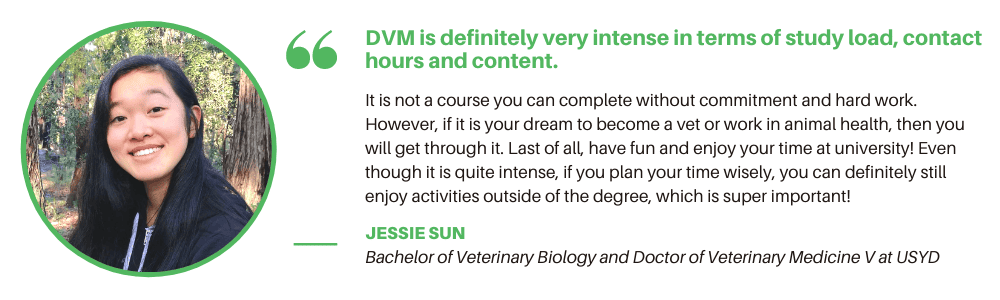
Since Bachelor of Veterinary Biology and Doctor of Veterinary Medicine students spend most of their week in university classes, it is important that the faculty bolsters their students’ confidence. At Sydney Uni,Veterinary Science staff are generally very supportive and want to help students maximise their potential.Jessie finds that the staff ‘really enjoy teaching and like having students that are excited and curious’!
Thefacilities and vet hospitals are well-stocked and up-to-date,especially during the Doctor of Veterinary Medicine. In addition,students can get quite close to the cohort in the postgraduate years, since students have all their lectures together and some tutorial and practicals. It is helpful to lean on your friends during these stressful times!
Culture
Itcan be hard for Veterinary students to fit in societies because of the contact hours如果他们并不住在校园附近。然而,VetSocis a great society to join as they hold many fun events such astrivia nights, Q&A sessions and picnics.
There are also several student-run groups that cater to specific areas of interest for students, such as thePathology Interest Groupand theEquine Specific Interest group!
Lynn Chenis a Content Writer at Art of Smart Education and is a Communication student at UTS with a major in Creative Writing. Lynn’s articles have been published in Vertigo, The Comma, and Shut Up and Go. In her spare time, she also writes poetry.

