
Oftentimes, the secret to getting yourself from a Band 5 to a Band 6 HSC Chemistry extended response isn’t at all in what you’re saying buthow you’re saying it.
Never is this more obvious than in a Chemistry 6 or 7 mark question.
重要的是要学习如何绝对粉碎好的化学反应,因为这是将“好”人与“伟大”人区分开来的原因。
The best part is – it’s actually pretty easy!
Step 1: Read the question
步骤2:计划您的答案
Step 3: Consider the use of diagrams, tables or flow charts
步骤4:描绘标记标准
样本响应
Step 1: Read the question
这听起来很明显,但是你需要挑出verbs and other directive terms that are going to define what direction you take.
我们创建了一个glossary of verbs taken from NESAthat you might find in your exam questions below!
Note:Because the NESA definition is not specific to one subject, a column is added to give you an idea of an appropriate approach to the question in the light of Chemistry.
| Verb | NESA Definition | Chemistry Approach |
|---|---|---|
| Account for | State reasons for | Consider the molecular mechanisms that underpin the reactions or observations. |
| 分析 | 识别特征及其之间的关系 | Usually for graphs or data, describe notable observations and any relationships between them. |
| Assess | Make judgement of value, quality, outcomes, results or size | Usually for long response questions, you will be required to make a judgement based on pros and cons without a certain criteria to adhere to. |
| Compare | Show how things are similar or different | For Chemistry, these responses are often done best in table form. Eg. Column 1 can note similarities while column 2 can describe differences. |
| 批判性(分析/评估) | Add a degree or level of accuracy depth, knowledge and understanding, logic, questioning, reflection and quality to (analyse/evaluate) | For Chemistry, these responses have to consider the molecular theories that underpins these reactions. Alternatively for scenario questions, these responses can also consider the societal, environmental and economical implications from the following reactions. |
| Describe | Provide characteristics and features | This is the easiest type of question - just note down what you see and know! |
| Discuss | Identify issues and provide reasons for and against | Unlike “evaluate/assess” questions, you DO NOT need to provide a judgement but you still need to list out the issues and provide arguments for and against your topic. |
| 评估 | Make judgement based on criteria; determine the value of | While you will need to provide a judgement like “assess” questions, “evaluate” questions focus more on whether objectives are being reached based on set standards. |
| 解释 | Relate cause and effect; make relationship between things evident; provide why and how | 确定基于观察结果的分子机制,并提出理论与观察之间的关系。 |
| Justify | Support an argument or conclusion | 在化学方面,支持您的论点的最佳方法是考虑结论的基础化学结构/特性。为了加强您的响应,您还可以考虑替代方案,并说明结果如何比原始场景更糟。 |
Ultimately, you need to address these directive terms to push your response into the Band 6 criteria. We’ll work through a question here as we go from a past HSC Chemistry paper.
让我们看看这个2014年HSC问题32(e)(7分)
解释how the differences in the structure and composition of soaps and detergents determine their uses and their impacts on the environment.
首先 - 动词。
根据NESA, ‘解释’means“relate cause and effect; make the relationships between things evident; provide why and/or how”.Thus, it’s perfectly acceptable to use“因果”subheadings to help make your answer clearer.
And now for other directive terms:“Differences in structure and composition of soaps and detergents”– so most of the differences come from the composition, but the question is telling you to address structure as well.
“确定他们对环境的用途和影响”- 这里有两件事:'uses’, and the ‘impact’.That means you have to address both with equal weight.
In your response, note down the chemical structure and composition of that class of surfacant.这是原因。
然后,表面活性剂的化学结构和组成如何有助于其对环境的使用和影响?This is the effect!
步骤2:计划您的答案
不仅仅是呕吐信息,您必须攻击教学大纲点。看看下面的示例答案,以查看有什么区别。
We’ll also plan out our answer to 32(e). There are four classes of surfactant, and for each we need to address uses and environmental concerns with reference to the molecular-level chemistry.
So, a good, easy answer structure that will tick all of the boxes might be:
- Surfactant one:(e.g. Cationic surfactants)
- Uses/environmental impact:pick one to go with here – we’ll write out a use for now
- Cause: The cationic amine group has a positively charged head.
- Effect: Cationic surfactants are great hair conditioners as the positively charged head of the surfactant will be attracted to the negatively charged wet hair, causing the non-polar ends to stick out of the hair, making the hair more shiny and manageable.
而且,您刚刚建立了一个简单的响应,目标是7/7!
Step 3: Consider the use of diagrams, tables or flow charts
请记住,您必须尽可能地保留提供空间的答案!
The more you run over the allotted space, the more risk you run of being penalised.
在视觉上表示信息可以比相同数量的写作更彻底地显示您的理解。跳到draw.io现在,尝试您的手构建良好的流程图。
In our example, it’s a great idea to include structural diagrams of the different classes of surfactant. This proves that know the structure yourself.
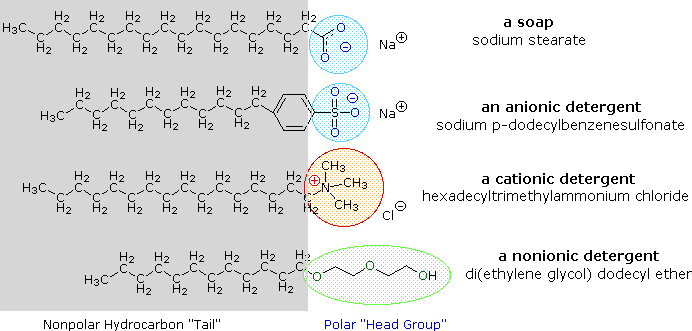
Here’s a good example of what your diagrams might look like – labelled with their identity, and also labelling the non-polar hydrophobic tail, and the hydrophilic head.
I do recommend using skeleton structures though, and don’t think you have to memorise the names!
步骤4:描绘标记标准
This can get a bit dangerous, because it’s very possible you can guess wrong. But that’s what practice questions were for!
You’ll be far more familiar with patterns in marking criteria than what you might realise.
What might be in our tester question?
Looking at it again, it’s pretty obvious there’ll be marks for了解结构和组成of different soaps and detergents.
In the same vein, there’ll be marks forunderstanding their uses, and environmental impacts(请记住 - 影响并不总是负面的!)。
Since it’s anexplain question,它们是阐明两者之间因果关系的标记。
And there’s always marks for beingclear and concise.
他们是我们的猜测but what are the real criteria?让我们来看看!
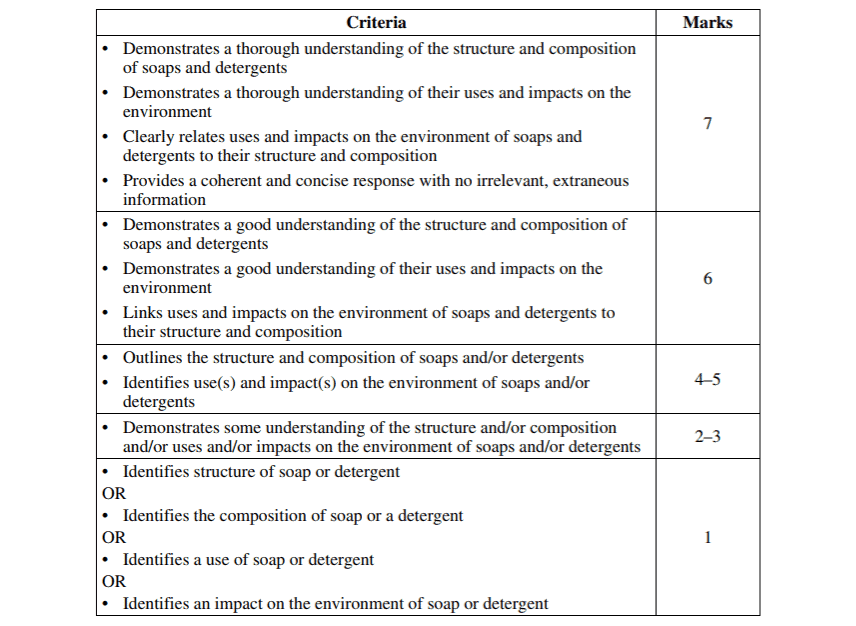
What do you know?Four for four! Having the idea of how to approach the question will go a long way towards getting into those top two brackets.
所以现在您知道了如何 - 尝试一下了!
I’ll leave the surfactant question for now – it’s from an option, so you may not need that material covered. And plus, this way you can try writing an answer for it on your own!
样本响应
So let’s use these steps to run through an example!
7标志:
关于基础化学和相关方程式,评估对乙醇两种用途的社会的影响。(2014 HSC化学考试)
Let’s be careful here and go through our simple 4-step process:
- 关键术语– underlying chemistry, assess (make a judgement of), impacts on society, TWO, uses of ethanol.
- Draw out the syllabus points– ethanol’s uses, the chemistry of ethanol, social impact. Select two uses – e.g. solvent and fuel. Establish what part of chemistry makes it useful in that field. Assess the impact on society.
- Adiagramof ethanol’s polar and non-polar ends would be useful for conveying its use as a solvent but also could consume a lot of space – be discerning! Same be said for a flow chart of ethanol as a carbon-neutral fuel. In this instance, I would recommend no – not enough space.
- 标记标准可能会出现什么?
- 将乙醇的化学连接到其用途
- Assessing the extent of its impact on society
- 正确和准确的equations
- Fluency and chemical literacy
For reference, here’s the actual criteria!
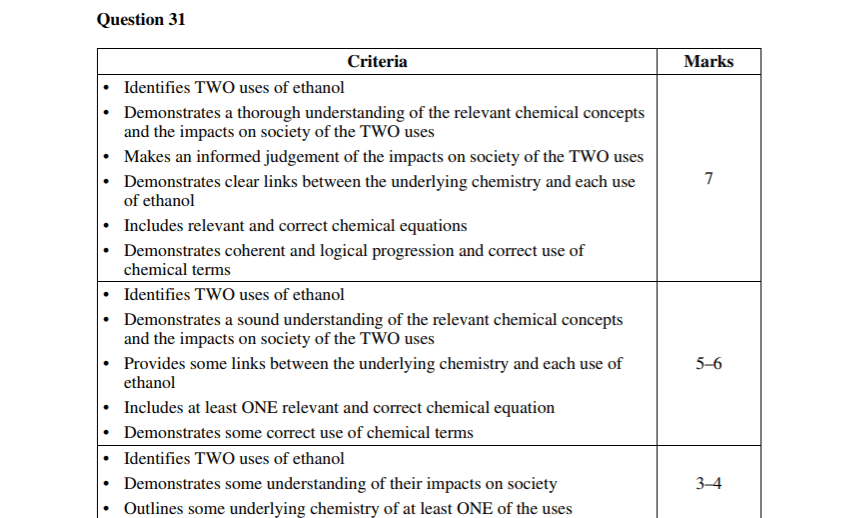
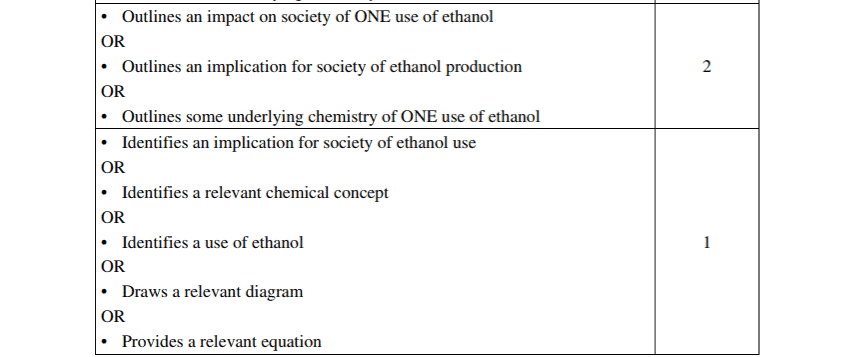
Bam. Our guesses were pretty much straight on.So let’s try this again.
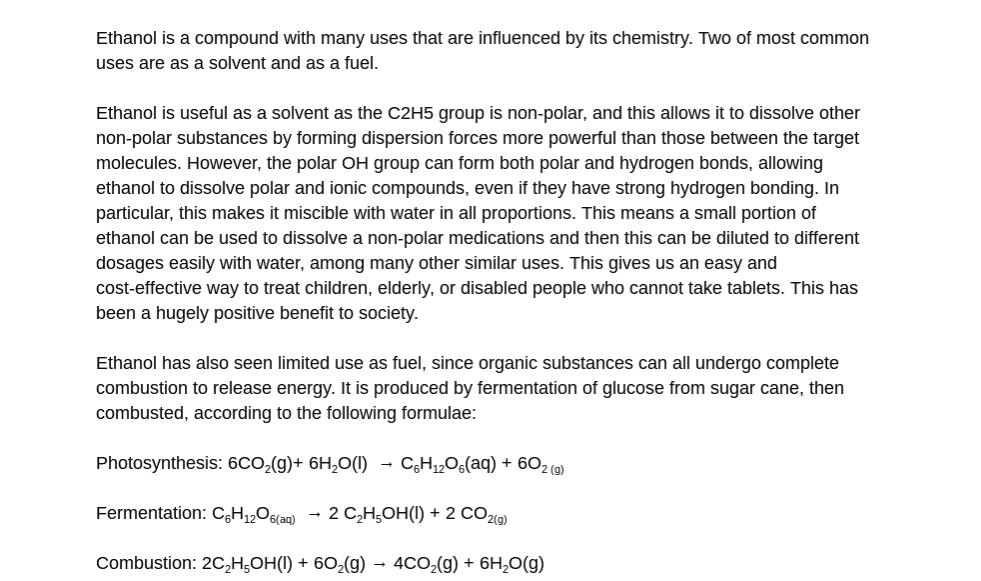
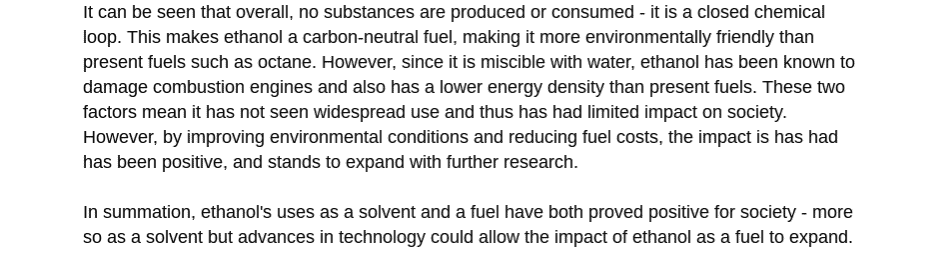
现在,这是一个很好的化学反应。
It’s a shame that it didn’t lend itself to diagrams, and also a shame that the formatting of the chemical states in the equations isn’t consistent, nor are they technically complete.
反应条件应写在箭头上方(这就是为什么我喜欢手写这些东西)。
But other than that, it covers everything.
It demonstrates a very deep understanding of the connection between the fundamental chemistry and its uses, awareness of the social dimension of the question and uses clear, concise language.
我不介意承认这种化学的扩展回答答案比我在实际考试中出现这个问题时提交的答案要好几百倍 - 我们都从错误中学习!这是一个简单的6,是7个强大的候选人!
I don’t like saying it’s a surefire 7 because that last mark has less to do with the quality of your answer and more to do with the quality of a typical answer.
The Chemistry exams are marked in such a way that there’s a roughly bell-curved-shaped distribution of marks, so the difference between 6 and 7 isn’t about being good –it’s about being better than everyone else.
For comparison,here’s a Chemistry extended response I might have written without considering any of the above points.
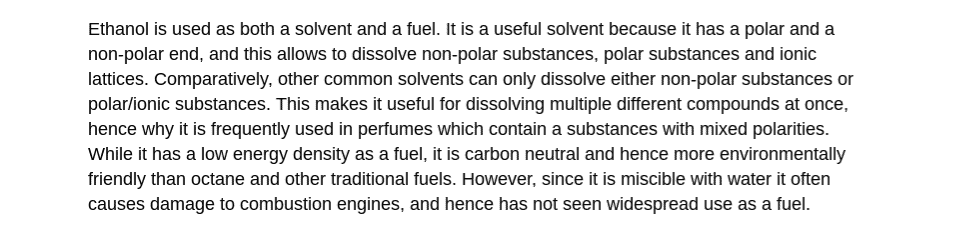
Okay, so这种化学的扩展反应有什么问题?或者,有什么问题呢?
它几乎完全ignores the social impactof both uses and uses an incredibly poor example of ethanol as a solvent. Of all the impacts that’s had on society, perfume would have to be the least meaningful.
On top of that,它浏览了相关的化学和has no equations,尽管碳中立的陈述绝对尖叫了三个。三个整个方程!
This answer would be lucky to score a 3/7 – with the equations! Without them, it’s almost destined for a 1/7. But, likewise, that bell-curve marking could pull it up to a 2/7 if there are some other really poor responses.
But why was the first Chemistry extended response so much better?
Because of practice, attention to detail and hard work.
Looking for extra help with HSC Chemistry?
We pride ourselves on our inspirational HSC Chemistry coaches and mentors!
We offer tutoring and mentoring for Years K-12 in a variety of subjects, with personalised lessons conducted one-on-one in your home or at our state of the art campus in Hornsby!
To find out more and get started with an inspirational tutor and mentorget in touch today!
Give us a ring on 1300 267 888, email us at[email protected]或检查我们Facebook!
马特·桑德斯is a huge nerd who first got into writing through fanfiction. He’d known science was the path for him since a young age, and after discovering a particular love of bad chemistry jokes (and chemistry too), he’s gone onto to study Forensic Chemistry at UTS. His HSC in 2014 was defined in equal parts by schoolwork and stagecraft, which left him, weirdly enough, with a love of Maths strong enough to inspire him to tutor any level, along with 7-10 Science and HSC Chemistry.