
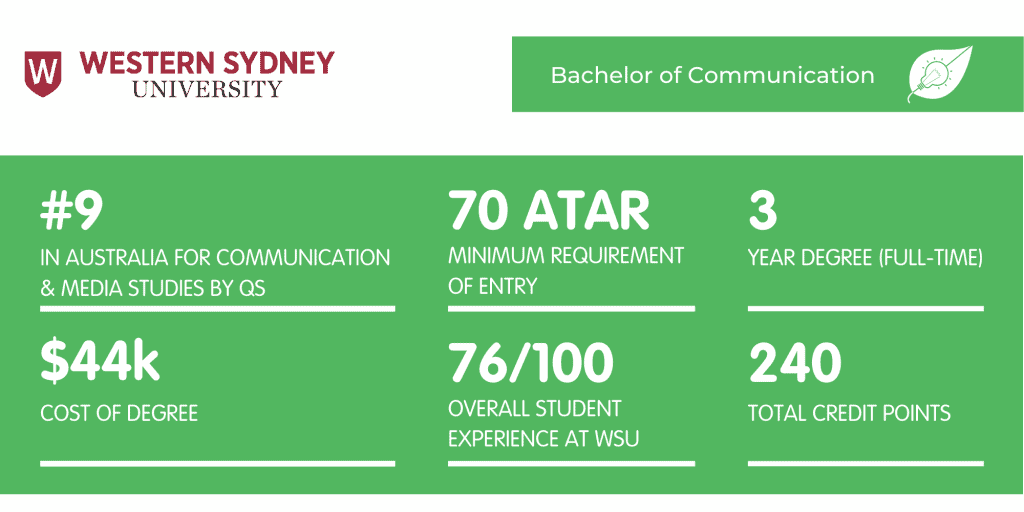
Are you passionate about telling stories, have a love for film or writing, and enjoy sharing ideas? If so, WSU Communications could be for you!
You’ll find everything you need to know about the units, assessments, culture and what studying Communication is really like at Western Sydney University right here.
Let’s get started!
What is a Bachelor of Communication at WSU?
Core Units and Majors
How to Get into Communications at WSU
What’s the Teaching Format?
What’s the Faculty and Culture Like?
What is a Bachelor of Communication at WSU?
A单身汉的沟通willequip you with the skills and knowledge you’ll need to work in media. Whether your passions lie in journalism, advertising, media arts, or public relations, you will learnhow to communicate with others and use the same tools and equipment you’ll find in the industry.
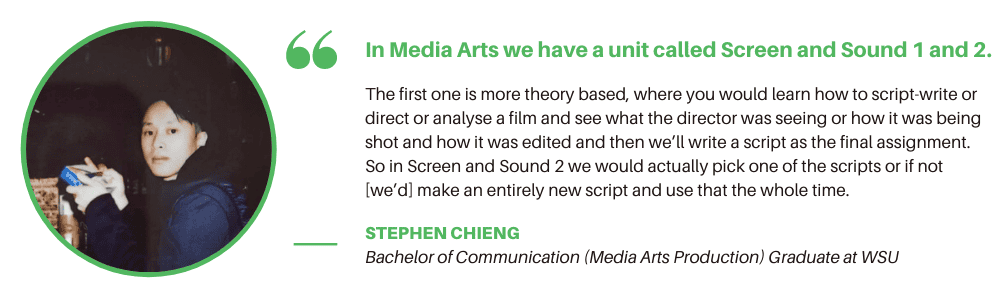
“If I were to summarise [Communication], it’s storytelling.” —Stephen Chieng,单身汉的沟通(Media Arts Production) Graduate at WSU
Can this degree be studied with another?
A Bachelor of Communicationcan also be studied as a double degree!
You canpair the degree with something similar— such as a Bachelor of Creative Industries —or something different— think a Bachelor’s degree in international studies, law, or business.But, if you choose to study a double degree in communication and business, your communication majors are restricted to advertising or public relations.
Honours
If the idea of academic research takes your fancy, you can also complete an Honours year. Undertaking an Honours projectgives you a taste of academic research in an area that interests you and helps you develop your skills in research and communicating your results.
At WSU,you can apply for a Bachelor Honours degree in your last semesterof your degree or if you only have a full semester of subjects left to complete.
To find out more about Honours and how to apply, headhere!
Career Paths
Communication is a huge part of our everyday life, sothere are plenty of career paths open to you once you have graduated. These include (but aren’t limited to):
-
- Print, TV, radio, or online journalism
- Current affairs
- Marketing
- Copywriting
- Publicist
- Copywriter
- Event management
- Media planner
- Editor
- Videographer
- 社交媒体编辑
- Advertising
- Public affairs
And, the Bachelor of Communication at WSU comes withprofessional accreditation with the Media Federation of Australia and the Public Relations Institute of Australia. This means that you’ll be recognised as having the necessary skills to work in media and public relations.
Have a read of our career articles onJournalismandProducing!
Core Units and Majors
What are the Core Units?
In your first year at WSU, you can expect tocomplete a suite of foundational subjects from all four majors. These includeintroductions to screen media, advertising, journalism, and public relations, as well as:
| Core Units | Description |
|---|---|
| Writing Ecologies | This unit lets you explore how social and cultural experiences shape and inform how we communicate and tell stories, and how communication has been influenced by networked technologies. |
| Media Cultures and Industries | 本单元将帮助你看媒体的its impact on society, how it works, and how it has changed over time — giving you the critical thinking skills to understand media as it continues to change. You will also get to create digital creative works. |
| Data, Mediation, Power | This unit looks at how data influences the ways we communicate and find meaning with the world, each other, and digital artefacts. You’ll be developing critical thinking skills by considering the limitations and possibilities that come with data and who benefits from it. |
| Public Relations Theory and Practice | This unit will expose you to the theories behind Public Relations — such as social science and research — and helps you develop the ability to solve different problems in a PR context. |
| Visual Storytelling | This is a hands-on unit, where you’ll learn how to use digital software and explore different ways of telling visual stories. You will develop image-making skills in different communication contexts and for specific target audiences. |
Second Year
As you head into second year, you’ll be required to complete two core units:Media Law and Ethics; and Professional Writing and Editing.
These units willfurther your understanding of the ethical and legal issues that affect professionals in the communication industry, as well as help you develop your writing and editing skills in a variety of contexts. This also means that you have room to take units from your major, sub-major, or electives.
Third Year
Just like second year, there aretwo more core units that you will complete in third year.This includes aCommunication Research Project,a capstone unit where you’ll work on a project of your own choosing, andMedia Memory, where you’ll consider how the past is utilised in the media and you’ll get to develop a research project.
Majors
Studying Communications at WSUgives you the choice of four majors to specialise in. These majors are taken from across the span of areas within communication and include:
-
- Advertising
- Journalism
- Media Arts Production
- Public Relations
If you are torn between twoyou can also choose to study one as a sub-majoror you can complete sub-majors in a variety of fields. You could sub-major in自主研究,认为土著澳大利亚的年代tudies and Indigenous Economics —Business Sustainabilityor a variety ofArts subjects,from languages and Linguistics to Philosophy and Psychological Studies.
Sub-majors can beless in-depth than majors, meaning that you will complete 40 credit points worth of subjectsrather than the 80 credit points you would study for a traditional major.
Internships
Though not compulsory,internships are offeredas part of the Bachelor of Communications at WSU and it’s highly recommended that you complete one!
Internships area great opportunity to test and use your skills in the real world, get a taste of life after uni, and network with people already working in the industry.Networking during your internship can be important for making connections in your field and can make finding paid work that little bit easier.
The internship持续的whole semester and requires the submission of a diary recording what you did while interning, so it’s best to not leave it until the last minute!
When it comes to securing an internship,WSU advertises a few that you can apply for during the year.You can also look for an internship on your own and it’s recommended that you do this too to increase your chances of receiving an offer.
How to Get into Communications at WSU
The ATAR cut off for a Bachelor of Communication at WSU is 70. The only exception to this is if you want to study at WSU’s Sydney City campus, where the ATAR cut off is 75 instead.
ClassStructure
If you don’t meet the ATAR requirements, there are plenty of ways to get in and kickstart your tertiary studies.
Headhereto find out about all of the different pathways WSU offers!
The College
The College isthe official pathway for students looking to enter a degree without meeting the ATAR cut off.With a range of Diplomas, Bachelor Degrees, Extended Diplomas, and University Foundation studies available, there are even more pathways into your dream degree.
For example,if you have an ATAR of 55 or higher you can apply for theDiploma in Communication/Bachelor of Communicationor you might consider applying for theDiploma in Communication Extended, which has no ATAR requirement. Once you complete the Diploma or Extended Diploma,you can transition directly into your second year of a Bachelor of Communication!
Early Entry
WSU also offers theHSC True Reward Early Offer program, which you can apply for before ATARs are released. Due to the disruptions resulting from the COVID-19 pandemic,students can now receive offers based on their Year 11 or Year 12 results instead of their ATAR.
You can find out more about the HSC True Reward Early Offer programhere!
Scholarships
Scholarships areoffered by both the School of Humanities & Communication Arts and WSU.For Communication students, there are specific scholarships including:
-
- Network 10’s Sandra Sully Scholarship in Journalism:Value of $7,500 for one year, eligible students must Australian citizens or permanent residents that are starting or continuing to study a Bachelor of Communications majoring in Journalism.
- Ellen Rigby Memorial Scholarship:Value of $5,000 per year for the whole degree (up to 5 years), female students who live in Western Sydney, are Australian citizens or permanent residents, can demonstrate financial hardship, and are currently enrolled or intend to enrol in an undergraduate degree in the School of Humanities & Communication Arts are eligible.
You can check out the full list of scholarships on offerhere!
What’s the Teaching Format?
To undertake a Bachelor of Communications at WSU, you willstudy for two semesters a year.The subjects cover a mix of theory and practical skills, which you will learn about and hone inlectures and tutorials.
Class Structure
A Bachelor of Communicationencompasses a mix of theory and practical skills, meaning that you can expect to attend a combination of lectures and tutorials, as well as the occasional excursion.
Lectures
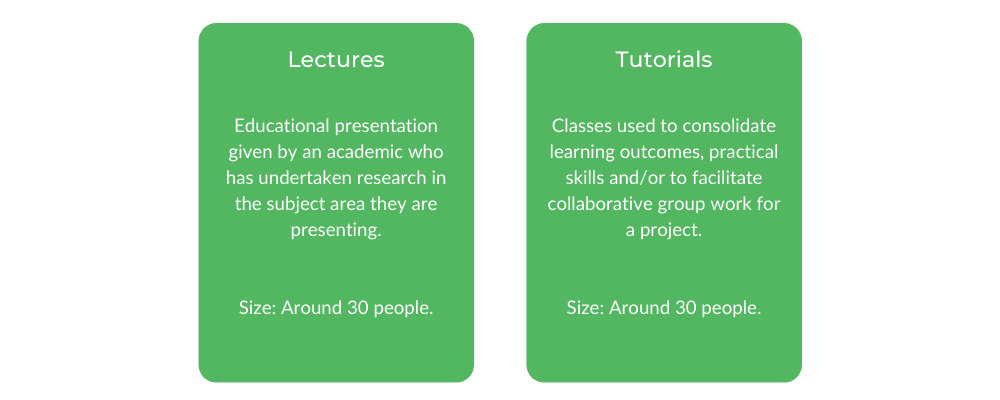
Lectures are about1.5-2 hours long, and are where you’ll beintroduced to different concepts, techniques, and other theoretical aspects of your subjects.
In your first-year core units, the whole cohort attends so lectures tend to be online and quite large. As you progress and study subjects that are specific to your major, these tend to be face to face and much smaller, witharound 30 people attending.
Some subjects will alsohave online lectures that you will need to watch before class, as well as daily readingsthat you will need to complete in advance.
Tutorials
Since theory is covered in lectures,tutorials are where you can develop your practical skills and apply your theoretical knowledge.These classes tend to run for1-1.5 hoursand can haveup to 30 people attendingduring more popular time slots.
In first year, you can expect todiscuss weekly readings, work through questions, and work in groups to respond to advertising briefs.
As you start to study subjects that are more specific to your major, tutorials become even more hands-on. For example, you might learn how to use different kinds of cameras and use them to recreate photos taken on campus.
Excursions
Some subjects also offer excursions, whereyou can tour radio stations and other facilities instead of attending class. This can be a great opportunity tosee what working in the industry is like before you finish your degree, and can be an opportunity to network!
How many hours do you have to go to university?
This degree has one of the fewest amount of contact hours, with full-time students attending universityattending 2-3 days a week on average. And if you get your timetabling right, you might only have to attend as little as 1 day a week!
While some subjects have more contact hours than others,you can generally expect to attend university more (up to 4 days a week) as you start to undertake more senior subjects.
What are the assessments like?
Since Communication at WSU is a hands-on degree, the majority of your assessments will take the form ofassignments, quizzes, and competency assessments.
Though the specific combination will vary subject to subject,assignments tend to form the bulk of your assessments. This also means thatyou won’t have to worry about studying for exams for most (if not all) of your subjects!
Assignments
Whether that involveswriting articles, making a documentary or pilot episode, writing scripts, or responding to advertising briefs, assignments allow you to practice and hone your skills. While each unit will be different,you can generally expect to complete 3 assignments worth anywhere from 20%-50% each.
Quizzes
Some subjects will also assess your knowledge through quizzes. These areworth much less than assignments(weighing about 15% overall), they can beuseful for testing your knowledge as you progress.
Competency
For some of your more practical second year subjects, you will need to pass competency assessments. These arepass/fail style assessments, where you need to show that you have particular skills, such as knowing how to use particular equipment, setting up a tripod, or being able to book the equipment you need.
Skills You Develop
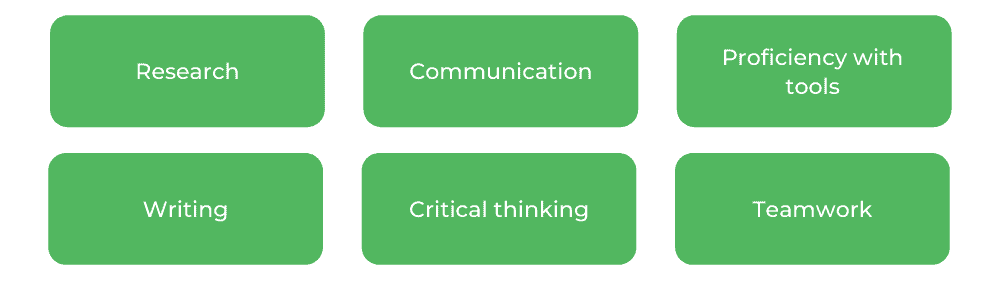
Studying a Bachelor of Communication at WSU willgive you the core skills you will need as a media professionaland those you can use in any workplace.
你会与abili毕业ty toconduct research and apply critical thinking and analytical skillsto solve a variety of problems. And, the emphasis ongroup work and presenting your ideaswill enable you to develop your ability to work in teams, communicate and compromise with others, and think on your feet, all of which will serve you well in your professional life.
The practical aspects of the degree will alsoexpose you to the different tools used by professionals across the media industryand within the field that you choose to specialise in. This will help youbecome familiar with tools and equipment before you enter the workforce,and you’ll learn how to work like a professional.
And, not surprisingly, you will learnhow to write and present ideas to your target audience,as well as how to write content with purpose.
“What I was taught is that whenever the camera is turned on, if you’re behind the camera you stay silent. … Whenever we hit the record button, I’m dead serious.”— Stephen Chieng
What’s the Faculty and Culture Like?
Faculty
The faculty within the School of Humanities and Communication Arts consists ofacademics and industry professionals who are passionate and knowledgeable about their subjects.As you progress through the degree, you’ll get to know the lecturers and tutors that teach subjects specific to your major andthey are often happy to help look over your work.
Lecturers and tutors hold their students to a high standard too, andwhile feedback can sometimes come across a bit critically it helps you improve your skillsand grow as a creative.
Culture
Due to the structured nature of the degree and the focus on working in teams,the cohort becomes tight-knit as you progress and it’s easy to make friends within your year.You’ll also find that the people you study with are a creative and diverse group that share a passion to tell stories.
Societies
When it comes to societies at WSU, there is plenty of choice.With over 130 clubs and societies, you’re sure to find a few that suit you!
For Communication students with an interest in film, joining theWSU Film Clubis a great place to start. The society runsscreenings of short and feature films, as well as film challenges and sessions where members can catch-upand create.
Writers, photographers, and aspiring editors can also joinW’SUP— WSU’s student newspaper — or find work experience and other career opportunities withWesSyd Media.
There are also opportunities tosubmit your work to external publications and festivals around WSU.For example, Media Arts students can submit their films to festivals such asMade In The West, a festival for Western Sydney filmmakers, and get the chance to have their film screened or win an award!
Want to know the pros and cons of WSU Communications? Check out our article here!
Rachel Fieldhouseis a Content Writer at Art of Smart Education and has just completed a double degree in Science and Arts at The University of Sydney, majoring in Chemistry, English, and Linguistics. Rachel’s writing has been published in Concrete Playground, Inside Enterprise, Planting Seeds, and SURG FM, and she currently writes blog posts for Remi AI, a Sydney-based Artificial Intelligence firm. When she’s not writing, you can find Rachel playing her saxophone or flute, or relaxing with some sudoku.