
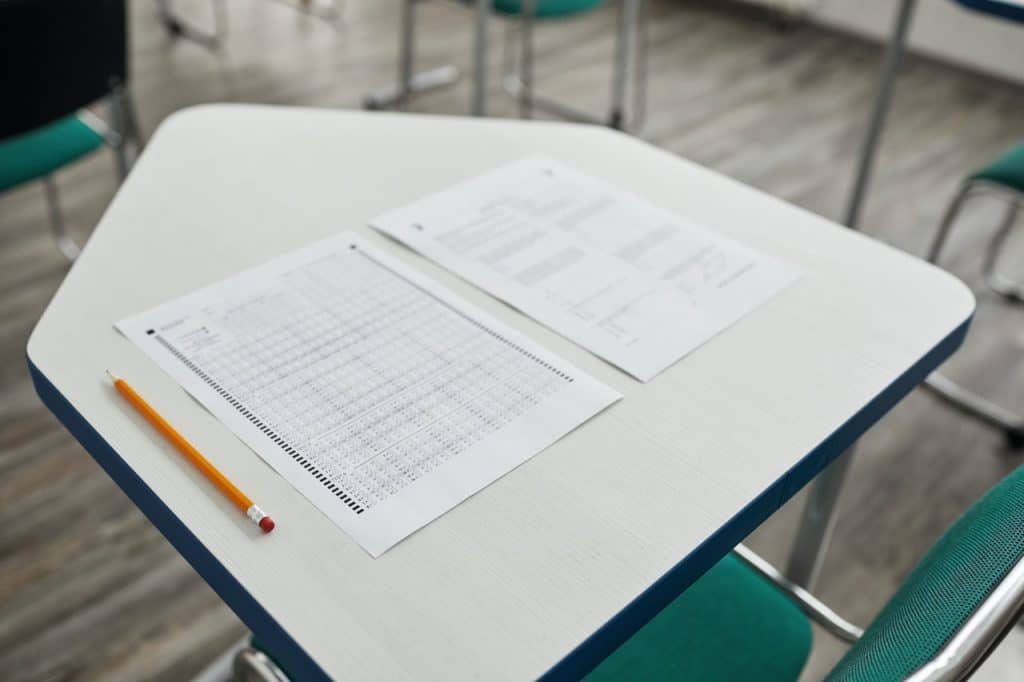
Are you trying to help your child get into an OC class or selective school? Want to give them the best chance of success? Winner of Art of Smart’s Primary Student Success Award, Kimberley gives her top 3 tips!
金伯利曾与几个小学tudents and comes from a background of Selective School test and OC test prep — so she knows what she’s talking about!
Keen to discover her tips for completing the OC Test or the Selective School Test? Let’s dive in!
What are the OC and Selective School Tests?
Tip #1: Practice, practice, practice!
Tip #2: Treat every subject equally
Tip #3: Review your mistakes
What are the OC and Selective School Tests?
The OC Test
The OC test isfor Year 4 students entering Year 5 the following year.Opportunity classes are available at public primary schools that serve Year 5 and 6 students who have been identified as academically gifted through the OC test.
In 2022, the test is computer-based and will be completed online.
The OC Test Structure
The test is60 minuteswith no specific time allocated to each section.
| Section | Questions | Type |
|---|---|---|
| Reading | 14 | Multiple choice |
| Mathematical reasoning | 18 | Multiple choice |
| Thinking skills | 18 | Multiple choice |
The Selective School Test
The Selective School Test isgenerally held in March and done by students in Year 6 entering Year 7.However, it is held every year and spots in Years 8-11 at selective schools continue to be sought after.
These testsprovide entry into specialised streams at schoolthat are designed to help enrich students who have shown advanced academic ability.
The Selective School Test Structure
| Section | Minutes | Questions | Type |
|---|---|---|---|
| Reading | 40 | 30 | Multiple choice |
| Mathematical reasoning | 40 | 35 | Multiple choice |
| Thinking skills | 40 | 40 | Multiple choice |
| Writing | 30 | 1 | Open Response |
Tip #1: Practice, practice, practice!
The selective and OC exams while challenging aretypically full of questions that are just variations of those in past years. Now this is a good thing for students!
This means that justby completing these papers your child will become more confidentas they are more familiar with the structure of the tests and its questions.
Do it under timed conditions
For most students, this will be the first time that they’re doing a test under timed conditions. To help them perform their best on the day, the greatest thing you can do ishave them completing practice tests under those same circumstances!
This means they’ll get more comfortable with working under pressure and sitting still for that long.
This way you can also seewhich areas they may be spending too long on and figuring out the best ways to split their time.By keeping track of this and practising beforehand, by the time of the real thing, they should be able to complete the test in time with ease!
Tip #2: Treat every subject equally
All the sections of the selective test are weighted equallyand so it’s important your child’s study reflects that. While they may have natural talents in English and are happy to practise that area, this probably means more emphasis should be placed on Maths study.
At the end of the day a really good English mark doesn’t really outweigh a terrible Maths mark, so don’t let your child go in with that mindset is what Kimberley says!
Tips for the Different Sections
Reading
The reading section exposes children to a variety of text types; NESA identifies“non-fiction, fiction, poetry, magazine articles and reports” as potential genres.Therefore it’s important your child has become familiar with these and is able to distinguish between them as questions pertain to the different purposes of these styles.
Mathematical reasoning
A key thing to keep in mind when your child is studying for mathematical reasoning isno calculators are allowed in the exam.This makes it a good idea for your child to practise their basic times tables and calculations in their head.
Thinking skills
Thinking skills, previously known as general ability,tests students’ critical thinking and problem solving skills.Students are unlikely to have come across these questions before and while studying for this area is harder than the others, getting your child familiar with the questions will be a great help!
Writing
Students will receive a topic to write about in this section.It is key that students address this and they are discouraged with using pre-written or memorised stories.
The grammar, punctuation, spelling and vocabulary of students will also be assessed in addition to their creativity and “ability to write effectively for a purpose and audience.”
Tip #3: Review your mistakes
While it can be hard enough getting your child to complete practice questions, what will really make the difference isthe review process.If your child is getting all the questions right, that’s great!
But if they’re getting it wrong, they need to know why. Because these tests are also multiple choice,it’s critical that your child is picking answers they feel confident in and understand are correct rather than hoping for the best.
It’s okay to get questions wrong — our mistakes actually tend to stick with us better!
Once they’ve identified where they went wrong and get into the habit of correcting their mistakes, their accuracy should improve drastically.If not, this might indicate your child doesn’treallyunderstand the question and theory behind it.
And that’s it! Those are Kimberley’s top 3 tips to help your child get into an OC class or selective school.
Looking for some extra help with your child’s studies?
We pride ourselves on our inspirational coaches and mentors!
We offer tutoring and mentoring for Years K-12 in a variety of subjects, with personalised lessons conducted one-on-one in your home or at one of our state of the art campuses in Hornsby or the Hills!
To find out more and get started with an inspirational tutor and mentor61beplay体育
Give us a ring on 1300 267 888, email us at[email protected]or check us out onFacebook!
Gabrielle Wongis currently the Social Media and Events Coordinator at Art of Smart. She is a third year student at the University of Sydney studying a Bachelor of Arts/Advanced Studies majoring in Media and Communications and Marketing.