
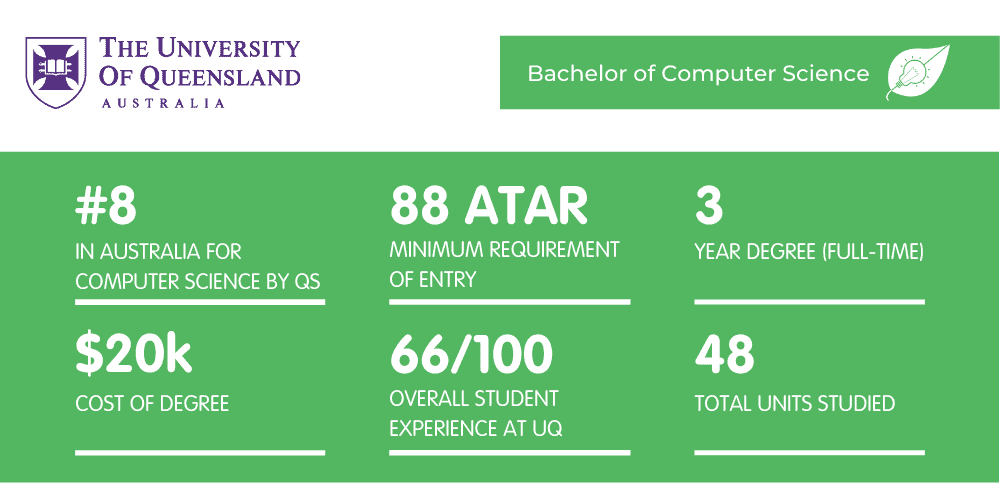
Do you like the sound of studying a Bachelor of Computer Science at UQ, but are put off by all the unanswered questions you have about the degree?
Committing to a single area of study after high school is a big and daunting decision. A lot of different things need to be considered and a lot of questions need to be asked.
To help make this process a little bit easier, we’ve compiled all the information you could possibly need about pursuing Computer Science at UQ.
Let’s jump straight in!
What is a Bachelor of Computer Science at UQ?
Core Units and Majors
How to Get into a Bachelor of Computer Science at UQ
What’s the Teaching Format?
What’s the Faculty and Culture Like?
What is a Bachelor of Computer Science at UQ?
A Bachelor of Computer Science at UQ教学生如何应用算法和data theory to real-life hardware and software systems.It focuses heavily on the process of problem solving to address issues involving technology.
Students graduate with an extensive knowledge ofcomputer programming, software development and data analysis.
This degree is ideal foranyone interested in working closely with computers, or simply looking toexpand their digital literacy.
Can this degree be studied in conjunction with another?
Computer Science at UQcan either be studied on its own, or as a dual degree。A dual degree offers students the chance to study Computer Science alongside another degree from a different faculty.
This allows students to graduate with two qualifications and ultimately expand their future career options. Popular course combinations includeEngineering, Laws, Business Management and Arts.
Honours
An Honours pathway is also available with this degree. Students in the Honours pathwaycomplete an additional year of study on top of the compulsory three years.
In this final year the curriculum focusses onbeing effective leaders in Computer Science roles.
To gain entry into this program, students must complete a Bachelor of Computer Science from UQ or any other approved degreewith a GPA of 5.0 within five years of applying.
You can find more information about the Honours programhere!
Career Paths
There are various career paths that this degree can send you down.After graduating, you could become a:
-
- Cyber security analyst
- Data scientist
- Machine learning engineer
- Software engineer
- Technical business analyst
- Data engineer
- Statistical analyst
- Security architect
Core Units and Majors
A Computer Science degree requires48 credit points worth of core units, major units and electives.The recommended full time study load is8 units per semester.
What are the Core Units?
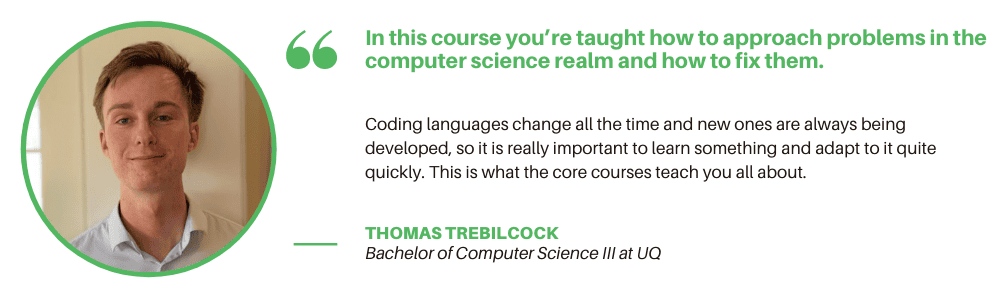
In first and second year, students complete their core Computer Science subjects, such asTheory of Computing,Introduction to Computing SystemsandAlgorithms and Data Structures。
All of these core subjects aredesigned to teach students the fundamentals of programming,providing a strong foundational knowledge for later years.
In Theory of Computing, students are shownwhy computer hardware is designed the way it is and how different programming languages can be usedto build all sorts of impressive software.
Introduction to Computing Systems explains everything aboutthe digital representation of data, looking at how data is digitally stored and communicated。
Finally, Algorithms and Data Structures introduces students toalgorithms, demonstrating how they are used to build complex programming and software.
“They teach you how to actually approach problems within the computer science realm and how to fix them.”— Thomas Trebilcock, Bachelor of Computer Science III at UQ
In the third year, the course structure focusses on the completion of Major units and selected electives.
What are the Majors?
While choosing a major isnot compulsoryfor this degree, it is highly recommended. This is because itoffers a further area of specialisation that can be advantageous in the workforce.
At UQ, students have five majors to choose from:
-
- Cyber Security
- Data Science
- Machine Learning
- Programming Languages
- Scientific Computing
What is Cyber Security like?
In this specific major, students learn aboutall things security in the digital world.
It covers things likehow to keep devices from attack or unauthorised access using programming and how to protect individuals, businesses and governments against cybercrime.
It also teaches studentshow to ethically hack computer softwareusing appropriate techniques and strategies.
The Cyber Security major hasa very practical focusand it is easy to see how the skills and content learnt can be applied to the workforce.
For more information about what each of these majors entail, head over to thispage!
Electives
On top of the required core units,students are given multiple opportunities to pick different electives.
Some of these include specific Computer Science electives, such asDigital Prototyping,Design ThinkingandIntroduction to Web Design。
However, students are also able tochoose from electives outside the Computer Science area of study.
These General Electives allow students toenrol in subjects belonging to any one of UQ’s different schools, including Architecture and Design, Arts and Humanities, Business and Economics。这种跨学科的学习等优点tageous for students, exposing them to different ways of thinking and learning.
How to Get into a Bachelor of Computer Science at UQ
TheATAR cut-offfor guaranteed entry into a Bachelor of Computer Science at UQ is88.
What are the prerequisites?
In addition to these marks, it is alsoexpected that students complete both a General English subject and a Mathematical Methods subjectin high school.
A Specialist Mathematics subject is not a compulsory prerequisite, but it is recommendedto give students greater flexibility with subject choice later on.
Alternate Pathways
If you do not meet the ATAR cut-off or the required prerequisites, do not stress! UQ offersvarious pathway programs and adjustment schemes to better your chances of acceptance.
There aremultiple bridging courses available in mathematics, chemistry and biology.These can help you meet subject prerequisites and gain skills needed to succeed at university.
Furthermore,UQ allows prospective students to use the Special Tertiary Admissions Test (STAT) to meet an english or mathematics prerequisite, as well as gain a selection rank.It can be used on its own, with employment experience or alongside Vocational Education and Training (VET) qualifications.
Scholarships
TheAlumni Advantage Scholarship in Computer Scienceis one of the scholarships offered at UQ to help disadvantaged students access university. This particular oneawards $3000 to Computer Science students from an “under-represented cohort”such as those facing financial hardship.
What’s the Teaching Format?
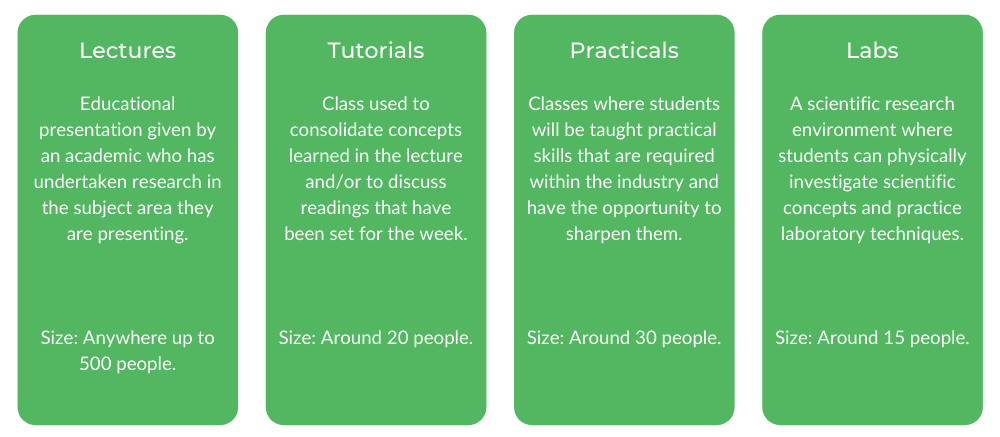
UQ structures their teaching year usingsemesters。Content is taught through a combination oflectures, tutorials, practicals and labs.
It is a fairly rigorous workload, withstudents expected to complete 30-40 hours of study a week,including each of the aforementioned teaching formats and self-directed study.
Class Structure
Lectures
Lectures are approximately2-3 hours in length and involve highly respected academics explaining course content using a presentation-style structure。They are often held in a large auditorium and live-streamed for people to watch from home.
Lecture sizes vary depending on the size of the course’s cohort, but they are usually quite large,with up to 500 students attending.
Tutorials
In tutorials, thecontent covered in lectures is further explained and unpacked to a smaller group.In this setting, students work closely with tutors and academics to ask questions and engage with important course information in a smaller and more casual setting than that of the lecture.
Here,a strong focus is placed on covering and understanding the theoretical components of the courseso that this knowledge can be properly applied to practicals and labs. Tutorials are approximately an hour long and have20 students in attendance。
Practicals
In practicals, tutors walk students throughhow to practically apply the theory learnt in lectures and tutorials.In groups ofabout 30,students run through basic programming challenges to familiarise themselves with the new content learnt.
They do this with close guidance from their tutors, a proximity which exists in practicals that make them the ideal place for students to get valuable assistance on assignments when needed.
Labs
Labs differ from practicals in the sense that theyinvolve more independent work from students。Rather than being guided every step of the way by tutors,labs encourage students to independently work on programming and coding problems relating specifically to the theoretical content covered that week.
They are usually timed and assessed, meaning thatthey provide a good gauge of how you are fairing with coursework throughout the semester.A typical lab is made up of approximately15 students.
Assessments
Assessments are a combination ofexams and assignments, with theoccasional essay thrown inthe mix.
Exams are usually a series ofmathematical equations or coding problemsthat students are required to solve on paper under timed conditions.
Assignments arelonger math and programming questionsthat are turned into multi-step projects that students must solve.
Skills You Refine and Learn
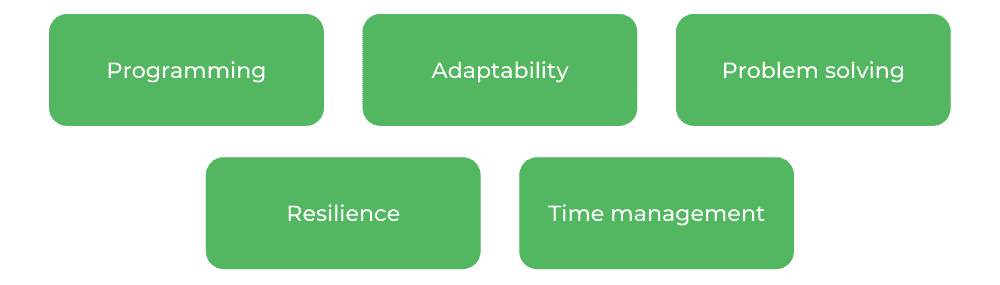
UQ Computer Science students’ are taught a range of important skills which help them become highly competitive job-ready graduates. Since the degree’s teaching style focuses heavily on students solving complex problems in a digital landscape that is always shifting,the main skill sets taught are problem solving and adaptability.
In this degree, students are faced with really challenging programming problems, which more often than not, take a lot of trial and error to solve. As a result,students quickly learn to be resilient when dealing with difficult problems.
As mentioned before, this course has a pretty heavy workload.The computer concepts students are being introduced to are pretty heavy and can take quite a bit of time to fully comprehend。Because of this, students in this course learn to developstrong time management skills.
What’s the Faculty and Culture Like?
Computer Science at UQ is a really friendly and supportive cohort.Because it’s quite a challenging course, the cohort gets significantly smaller as the degree progresses。因此,有一个真正意义上的camaraderie between the students that does remain.
The ability for Computer Science students to choose General Electives in other areas of study also means thatyou are able to meet and befriend people from all types of disciplines.
“A cool thing about Computer Science at UQ is that a lot of the classes you do mix with other disciplines like Electrical Engineering or Software Engineering. So I’ve actually made a lot of great mates from those courses.”— Thomas Trebilcock
The teaching faculty is said to be excellent and incredibly helpful.The faculty is relatively large, meaning that students feel very supported by staff who are always readily available to answer any questions.
Societies
TheUQ Computing Societyis the most relevant society to this degree.
They host a lot of events throughout the year, includingnetworking functions, tutoring sessions and casual catch-ups over a few drinks.
Support Programs
UQ offers a range of student support services.For first-years, theGet Set programconnects new students in similar or same studies with student mentors tohelp make the transition between high school and university easier.
TheMeet a Mentor programconnects engineering, architecture and IT students with professionals to help motivate, educate and empower future graduates. This program isavailable to second and third year students, helping them gain industry connections which may assist with future employment.
Jessica Arentzis a Content Writer at Art of Smart and an undergraduate student at the University of Sydney where she studies a Bachelor of Arts/Advanced Studies (Media and Communications) (Marketing). She currently volunteers at 2SER community radio station as a producer and newsroom reader. When not writing, you can find Jess searching the web for cheap flights or spending her days with her head buried deep in a book.