
With the newHSC Chemistry模块7及其对有机化学的关注,我们经常看到并研究含有碳和氢原子的化合物,即有机化合物的商标原子。
Organic compounds exists all around us and in us too, as we are constantly making, breaking and using organic compounds to do basic things like eating, sleeping and scrolling through Instagram.
在本文中,我们将探索新‘茵特罗德女士’uced topics, a breakdown of Module 7: Organic Chemistry by its inquiry questions with some tips on how to get a Band 6 for this subject!
因此,让我们开始吧!
模块7的更改:有机化学
Breakdown of Module 7: Organic Chemistry
如何在模块7中获得频段6:有机化学
HSC化学模块的一般变化7:有机化学
此前,有机化学是通过分散hout different modules in the old syllabus.
The new HSC syllabus grouped all chemical reactions involving organic compounds into one cohesive module.
Its refined focus on organic compounds illicit a deeper understanding of how structural and chemical compositions can determine the properties of substances. More importantly, how properties of a substance can decide its reactivity with other similar or different compounds.
InYear 11 Module 3: Reactive Chemistry, we learnt about how INORGANIC products are formed by reactions such as synthesis, combustion and acid/base reactions.
In Year 12, we will now be applying this understanding of product formation with ORGANIC molecules.
As discussed in previous articles, the new syllabus has adopted a more depth-over-breadth exploration of concepts in chemistry; prompting understanding and application over route learning.
随着有机化学的舞台,学生需要了解化学结构如何确定与其他分子的功能和反应性。
Breakdown of Module 7: Organic Chemistry
在我们深入研究问题之前,如果您需要回顾HSC化学的概念,确保您一起前往HSC,其中有免费的视频资源来解释每个教学大纲点中的概念!
查询问题#1:我们如何系统地命名有机化合物?
“说我的名字……说我的名字。”大多数有机化合物都是Destiny Child热门歌曲的粉丝,因为您需要根据IUPAC规则来命名它们。
虽然命名看起来像树的结构公式可能很恐怖,但有机复合命名法的规则可能很简单。
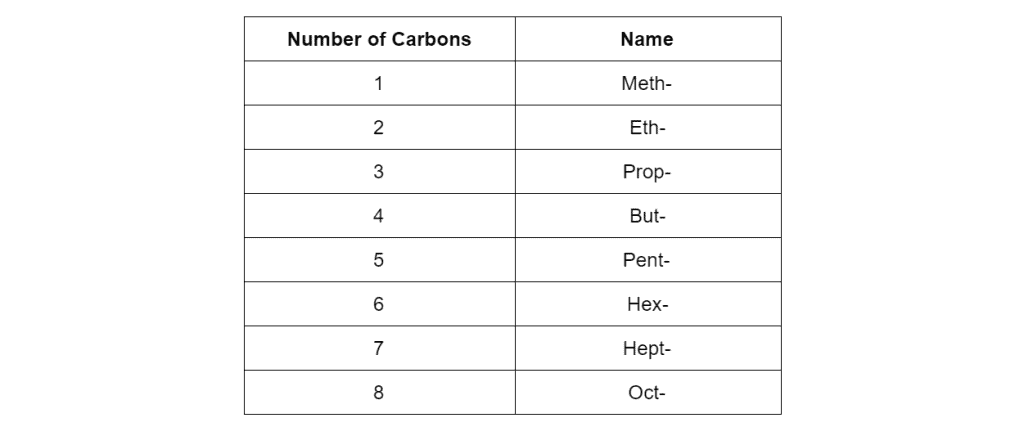
The first step is to remember the names of compounds with 1 carbon atom, 2 carbon atoms, etc. This is summarized in the table below:
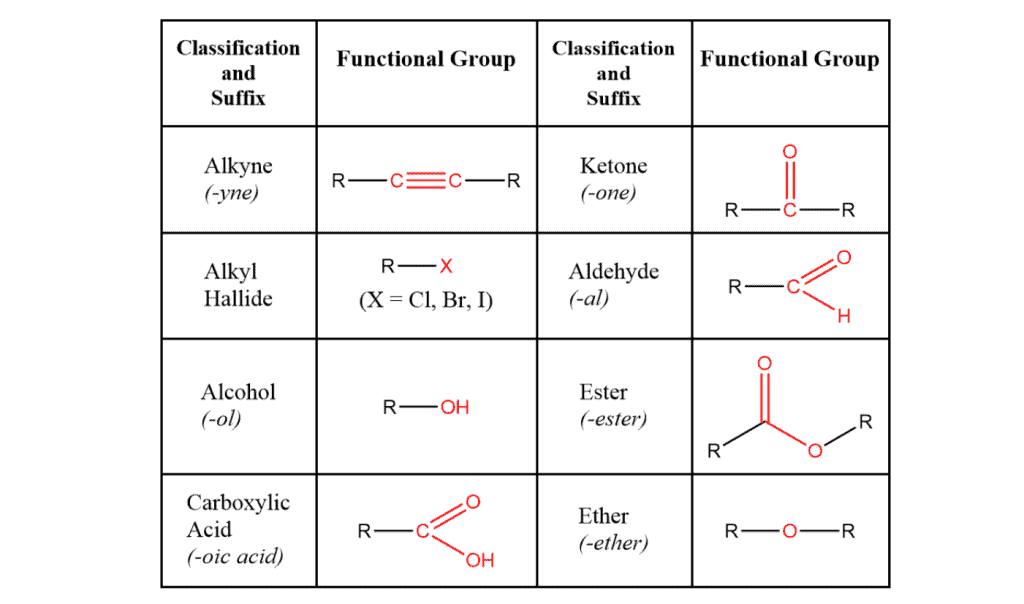
第二步是回忆有机底物类型之间的结构差异,例如烷烃,烷烃,炔烃,酒精等。将其应用于您的命名方案。
Third step is to label groups (bromo, fluoro, methyl) by the nth Carbon atom they are attached to. Remember prefixes! If you have two of the same group, it is called eg. di-fluoro. If you have three of the same groups, it is called eg. tri-fluoro and etc.
Fourth and final step is to ensure the groups are sequenced in alphabetical order in the name.
If your’e struggling, you can find an example of how to name hydrocarbons这里, a quick video introduction to the topic这里and lastly, a tutorial to naming organic compounds这里!
Inquiry question #2: How can hydrocarbons be classified based on their structure and reactivity?
Organic chemistry compounds such as alkanes, alkenes and alkynes are very similar to real life friendships and relationships in terms of reactivity and bond strength.
尽管友谊由于牢固的单一键而坚持不懈,但有机分子在其结构内的原子之间具有牢固的纽带时,与他人的相互作用也较少。同时,就像与两个或更多人的友谊一样,具有两个或三个键的有机化合物往往具有高度反应性,并与其他分子反应。
烷烃(单键),烷烃(双键)和炔烃(三键)的反应性分别增加。
This is because alkanes, with a strong single bond is stable without the presence of a reactive double or triple bond. Alkenes on the other hand, have an unstable double bond that is itching to react with another compound. The same can be said about the triple bond of alkynes, who cannot wait to find another friend to react with.
Note:Alkanes with single bonds are known to be SATURATED with hydrogens. Meanwhile, Alkenes with a double bond(s) and Alkyenes with triple bond(s) are known to be UNSATURATED.
Inquiry question #3: What are the products of reactions of hydrocarbons and how do they react?
So what else do organic molecules interact with?
从有机分子的友谊动态之后,具有强键键的烷烃仍然忠诚,并且不太可能与其他分子反应。
This is partly because alkanes is already SATURATED with Hydrogen atoms!
As alkanes are loyal organic molecules, the only way for it to react with another molecule is to substitute one of its Hydrogen atoms with another chemical substance via substitution reaction.
This chemical substance could be either hydrogen, halogens, hydrogen halides or water.
烯烃和炔烃也可以与这些化学物质相互作用。Unlike alkanes however, alkene and alkynes can easily interact with these substances because of their reactive double/triple bonds and UNSATURATED status.
为了使烯烃和炔烃饱和,这些有机化合物通过添加反应与其他物质反应。
Inquiry question #4: How can alcohols be produced and what are their properties?
OH, OH, OH it’s alcohol!
酒精与烷烃相似,但它没有正常的无聊的碳氢化合物,而是羟基(OH)组。
This hydroxyl (OH) group induces intermolecular forces such as hydrogen bonds, dipole-dipole forces and dispersion forces.
This OH group is handy in performing oxidation reactions, dehydration and even preventing incomplete combustions!
Because of alcohol’s many uses, it has a high demand! Luckily, alcohol can be produced via substitution reactions with halogenated compounds or fermentation.
查询问题5:有机酸和碱的特性是什么?
现在,在我们对羧酸和氨基碱(例如胺和酰胺)的重新审视之前,该主题还包括醇,醛和酮等新群体。
Structural formulas can be referenced below!
Besides normal acids and bases interactions, we will take on a clean approach to new reactions such as esterification, the formation of perfumes and saponification, the production of soaps and detergents. How exciting!
来自化学Score
查询问题6:聚合物的属性和用途是什么?
想象你有一个弦。您将一个珠子放入绳子中,然后将另一个和另一个珠子和另一个珠子放在弦上。最后,您停下来并打结绳子,并有一条手镯!
That is what polymerization is. The beads represent monomers, individual organic compounds that add on and on. The process of adding on monomers (beads in the metaphor) is called polymerization. Once that has ended, polymerization has terminated and you have a bracelet, or in chemistry terms – a polymer.
Polymers are in what you use in everyday life! From the polystyrene that keeps your food warm to the polyesters in your shirts, polymers make up every bit of our living.
That is why it is important to see how its structure, composition and interaction with others make up your clothes, containers and whatever else you can think of!
How to Get a Band 6 for in HSC Chemistry Module 7: Organic Chemistry
Tip #1: Memorise your nomenclature and structures!
To master the Band 6 content, it is always best to master the basics first.
To memorise effectively, try and test yourself!
Attempting to write names or draw structures for many different types of organic molecules will broaden your scope. Soon enough, any molecule in your way will be a breeze for you.
Feel free to take note of any organic compounds that you struggle to name or draw. Discussing them with your teacher is a great way to confirm which nomenclature or structure will earn you the most marks in the exam!
Tip #2: Collaborate with your peers and teachers
Because some of the concepts are new in HSC Chemistry Module 7, it may be difficult to access relevant practice questions and their corresponding answers.
与朋友合作是分享您的资源和彼此理解的好方法。也许他们的解释方式可能会睁开眼睛,以一种全新的观察方式和记住您以前遇到的概念。也许他们可以向您展示您找不到的资源。
同样,每当您不确定问题,主题或答案时,也不要害怕与老师接触。与老师的讨论总是很方便的,因为他们可以为您提供有关您的标记6学生所期望的线索的线索。
But doing one or two practice questions is not enough. In order to master the topics you have struggled with, it is always best to practice, practice and practice.
Excel HSC过去论文工作簿的2019年更新版本是列出模块所有相关HSC问题的最佳资源之一。
So what’s stopping you? Let’s start practising!
Tip #3: Apply theory in your pracs
As you are performing your experiments, try to account for what is being observed.
这意味着将您在课堂上学到的概念付诸实践!
A good way to apply your knowledge is to prepare for practicals by re-reading any relevant chemical concepts that forms the basis of the experiment.
That way, you can actively apply what you have read earlier that week to what you see during your practical lesson!
When revising for Module 7: Organic Chemistry, always ask yourself these questions:
- 这些有机分子之间有什么结构差异?
- 这些结构成分如何有助于其与其他分子的相互作用和反应性?
By asking yourself these questions every time you perform a new reaction in class, you’re essentially applying your understanding of chemistry to many different organic chemical reactions!
And that wraps up our guide to HSC Chemistry Module 7: Organic Chemistry! Good luck!
在HSC化学方面寻找额外的帮助?
We pride ourselves on our inspirational HSC Chemistry coaches and mentors!
We offer tutoring and mentoring for Years K-12 in a variety of subjects, with personalised lessons conducted one-on-one in your home or at our state of the art campus in Hornsby!
了解更多,并从鼓舞人心的导师和导师开始61beplay体育
Give us a ring on 1300 267 888, email us at[email protected]or check us out onFacebook!
Kate Lynn Law毕业于2017年,获得了全面的HSC奖,ATAR为97.65。她热衷于指导,她喜欢与高中生一起工beplay安卓西西软件作,以提高他们的学术,工作和生活技能,为HSC做准备以及接下来的事情。凯特(Kate)是一位狂热的博客作者,自2013年以来,自2013年以来就为2000多人管理了一个创意写作页面,自她十几岁以来就写信给国际观众。