
So, you’re interested in studying a Bachelor of Biomedical Science at Monash?
Well, you’ve come to the right place because we’re going to take you through everything there is to know about the degree including the different majors, assessments, uni culture, scholarships and more!
Let’s get started!
What is a Bachelor of Biomedical Science at Monash Uni?
Core Units for this Degree
How to Get into a Bachelor of Biomedical Science at Monash Uni
What’s the Teaching Format?
What’s the Faculty and Culture Like?
What is a Bachelor of Biomedical Science at Monash Uni?
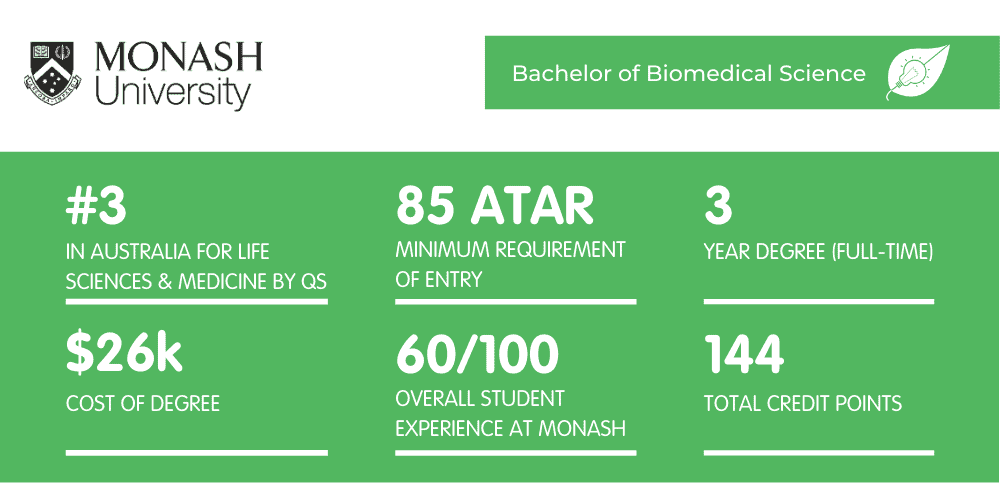
A Bachelor of Biomedical Science at Monashprovides you with a strong understanding of human health and disease as well as developing the skills you need for further research or a pathway into medicine!
You’ll cover five main topics throughout the degree includingMolecular and Cellular Biology, Body Systems, Infection and Immunity, Disease and Society as well as Diagnostic and Research Tools.You’ll also have the chance to tailor the degree to your interests as you’llcomplete eight electives.
If you’re thinking of pursuing medicine after completing a Bachelor of Biomedical Science, you canlearn more about Medicine at Monash here!
Can it be studied as Honours or in conjunction with another degree?
There’s the chance for you to completeHonourswhich adds on an extra year of study. During this year,you’ll work on a research project on a topic of your choice related to Biomedical Science.
To be eligible,you need to have an average of 70% in at least 24 points during your final year.
There’s also the possibility to take your Biomedical Science degree to the next level bycombining it with eitherCommerce,Engineering (Honours),Laws (Honours)orScience.
Career Paths
A Bachelor of Biomedical Science isa great pathway into medicine and can also lead on to further research in the field.Depending on what you’re most interested in, these are just some of the jobs you could find yourself working in:
-
- Biomedical scientist
- Clinical scientist
- Medical chemist
- Analytical chemist
- Microbiologist
- Research scientist
- Toxicologist
…and the list goes on!
Core Units for this Degree
Throughout the course of the degree,you’ll complete 14 core units and 8 electives.
Theusual semester would include three core units and one elective. However, in yourfinal year, you’ll have two double weighted core unit subjectswhich basically just means you spend more time on those subjects!
In the first year, you’ll cover basic science subjects likephysics, microbiology, genetics and anatomy.Then in the second year, it gets a little bit more specialised so you’ll look atpublic health and bioinformatics.
The final year is morepublic health and research basedwhere you’ll spend a whole semester doinga systematic review of literature on a certain topic(helps prepare you for after your degree and opens up doors for a career in research).
What subjects will you study?
The subjectMedical Biophysicsis all about how physics plays an important part in the functioning of the human body so you’ll look at a range of different physiological processes.Microbes in Health and Diseaseis a very interesting one as you’ll study infectious organisms and look at things like immunity, vaccines and so on.
The double weighted final year subjectBiomedical Basis and Epidemiology of Human Diseaseis all about the impacts of human disease in society and for one the assessments,you’ll have to write a 4000 word systematic review on a topic (plus give a presentation)which really helps develop your research and communication skills.
Take a closer look at all the core subjects below!
-
- Biomedical Chemistry
- Cells, Tissues and Organisms
- Medical Biophysics
- Public Health and Preventive Medicine
- Human Neurobiology
- Molecular Biology
- Structure of the Human Body: An Evolutionary and Functional Perspective
- Human Molecular Cell Biology
- Body Systems
- Human Genetics
- Microbes in Health and Disease
- Introduction to Bioinformatics
- Molecular Mechanisms of Disease(double weighted third year subject)
- Biomedical Basis and Epidemiology of Human Disease(double weighted third year subject)
Electives
You get to complete eight electives over the three year degree andyou can either choose electives that are relevant to your biomedical degree or you can select some inter-faculty electivesas long as your eligible (it varies for each subject).
You can alsouse your electives to do a major or minor in a different discipline(but you don’t have to). For more info, checkthisout!
Internships
The degreedoesn’t require you to do any internshipshowever, there is nothing stopping you from finding your own one and getting some experience! Plus a lot of the lecturers and tutors still work in the industry so they definitely would have connections.
How to Get into a Bachelor of Biomedical Science at Monash Uni
With an ATAR of 85, you’ll have guaranteed entryinto Biomedical Science at Monash university. However, in saying that, in 2020 there have been offers made for those who have an ATAR of 80.4.
Alternate Pathway
If you don’t get the required ATAR for this degree, there is another way — although it’s not as direct as guaranteed entry through ATAR;you’ll basically transfer from another degree.
To apply for this degree without relying on your ATAR,you’ll need to have completed at least one year of full-time study of a recognised university degree, achieving a minimum average mark of 70%. If possible, you might also want to study some of the first year core units in your other degree so that some of the credits can be transferred!
So it will take some work, but if Biomedical Science is what you’d like to study, the effort will be worth it!
Learn more about pathways into this degreehere(look below ‘Entry Requirements’)!
Are there any prerequisites?
To be eligible for the course, you need to have completed:
-
- English units 3 & 4:scored at least 27
- Maths units 3 & 4:scored at least 25
- Science units 3 & 4:scored at least 25 in Chemistry
Scholarships
There are all sorts of different scholarships you can apply for at Monash which can be foundhere!
It’s definitely worth checking out theBiomedicine Discovery Scholarshipfor high achieving students who are enrolled in or plan to enrol in a Bachelor of Biomedical Science!
What’s the Teaching Format?
在蒙纳士大学生物科学系学士taught throughlectures, tutorials and pracs(depending on the subject). Now, take a breath, these are all taught throughsemesters!
Class Structure
Lectures
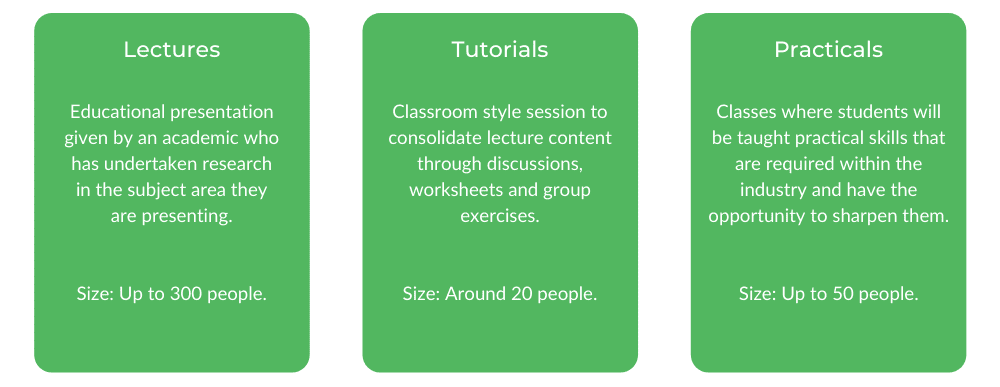
You could haveanywhere up to 300 peoplein a lecture and these go for an hour. You’ll usuallyhear from experts relating to whatever topic you’re studying.
Tutorials
You’ll havearound 20 people in each tutorialand these usually go for two hours! These are fairlysmall and interactive with group work based on the lecture content.
It really depends on the subject but you’ll sometimes havegroup discussions, sets of questions to work through and answer, small presentationsand of course,time for your tutors to answer any questions you may have!
Pracs
Sometimes you’ll havepracs for subjects like genetics, physics, microbiology and anatomywhich are a bit more hands-on. You can expect to haveanywhere up to 50 peoplein the pracs and they go for2-3 hours.
How much time do you spend on campus?
If you study a Bachelor of Biomedical Science at Monash full-time,you’ll usually take four subjects a semester. So, you can expect to havearound 20 contact hours a week!
Plus, don’t forget,you’ll also have to do a fair bit of work in your own time— studying, homework, exam preparation and assignments.
What are the assessments like?
There’s quite a mix! Usually you can expect to haveat least one exam per subject and a few quizzes along the way too.
Then there’sa few assignmentson top of that throughout the semester which could includeoral presentations, report writing, literature reviews and group assignments!
In terms ofassessments for the pracs, you often have towrite up a report and submit it after the class— sometimes this was done in groups but usually individually.
Skills That You Refine and Learn
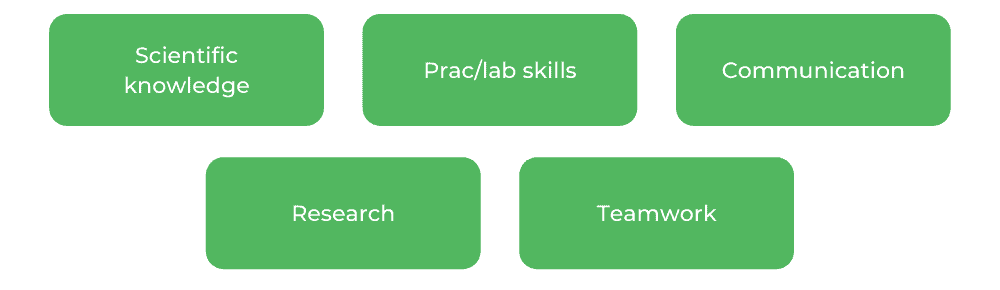
Well, of course, you develop yourscientific knowledge and skills!On top of that, you’ll refine yourcommunication skillsbecause there is a big emphasis on oral presentations so you learn how to communicate information to a lay person.
You’ll also write up lab reports and systematic reviews which helps to refine yourwritten communication and research skills!There are a fair few group assignments so you’ll learnhow to effectively work in a team.
What’s the Faculty and Culture Like?
There’s no doubt that it isa fairly competitive degree because a lot of people study Biomedical Science as a pathway into medicine. However, everyone usually supports each other and when you find your group of people, you’ll study and prepare for exams together and get to enjoy the campus life together. So,it’s definitely worth putting yourself out there and getting involved!
Biomed Society
You’ll definitely want to check out and join theBiomed Societyat Monash because it will provide you with both academic and social opportunities! It’s alsoa great place to easily make friends when you first start the degree.
There’s afirst and second year camp,Mystery Buswhich is a night of surprises at different Melbourne locations, pub crawls, bar nights and of course, the much belovedBiomed Ball!
In terms of academic and networking events, there areIndustry Nights, Corporate Cocktails where you get to network with and hear from industry professionalsplus various information sessions which prepare you for going into medicine!
Biomedical Science Peer Mentoring
This is一个伟大的计划as allfirst-year Biomedical science students are matched with an older Biomedical science student!They’ve been exactly in the same position as you and have made that transition from high school to uni so they really know what it’s like!
Your mentors willhelp you settle into uni and are there as a point of contact if you have any questions about uni life, the faculty, the degree or the assessments!There are also some有趣的社会事件和教授sional development workshopsfor you and your mentors to attend (this is also a great way to connect with more people and make new friends).
Interested in the pros and cons of this degree? Check out our article here!
Tanna Nankivell是一个高级内容作家艺术智能Educatibeplay体育官方on and is currently in Germany completing a year of study for her double degree in Communications (Journalism) and Bachelor of Arts (International Studies). She has had articles published on Central News – the UTS Journalism Lab and wrote a feature piece for Time Out Sydney during her internship. Tanna has a love for travel and the great outdoors, you’ll either find her on the snowfields or in the ocean, teaching aqua aerobics or creating short films.