

Have you got questions about HSC English?
Don’t worry, we all did! We’ve compiled the top 10 most Frequently Asked Questions about HSC English and answered them to keep you in the loop!
Let’s dive in!
Q1. How do I get full marks?
Q2. How do I choose a related text?
Q3. What’s the best essay structure?
Q4. Does the STEEL structure actually work?
Q5. How many words can you write in 40 minutes?
Q6. Should I memorise or improvise my essay?
Q7. What are all the literary and visual techniques?
Q8. How messy can my handwriting be?
Q9. How do I understand Shakespeare?
Q1. How do I get full marks?
Short answer:Fill all the criteria and answer the question perfectly.
Long answer:There’s no one way to get full marks on any exam, assignment or essay because what works for one person isn’t going to work for everyone.
English is incredibly subjective, and when it comes down to it, your success depends on how well you write and communicate your ideas.
We can help you out with ourUltimate Guide to Getting a Band 6 in HSC English herebut ‘there’s no such thing as a perfect answer’.
Getting full marks can make you complacent, and can be highly unhelpful in helping you to make further improvements.
The fact of the matter is that getting full marks isn’t the be all and end all of your studies so don’t obsess over that perfect 100%. Instead你应该看设定合理的目标and working towards them.
If you’re currently sitting on a 70% average, aim to push it up to 75% or even 80% by the end of the term! It takes a lot of hard work, but by moving along smaller goals like this you’ll see greater improvement and you’ll actually be much more likely to maintain strong marks!
There’s a helpful post on setting and achieving goals like these overhere.
Q2. How do I choose a related text?
Condensed, the main things you need to be thinking about aretopic themes,text typeandliterary merit.We have a whole article on selecting a strong related text over here:
This means you want a text that has similar or relevant themes to the topic your studying, as well as being a different text type to whatever prescribed text you’ve been given.
Literary merit is tougher to explain, but basically if your English teacher would scoff at the text, it doesn’t have literary merit (thinkTwilightandCaptain Underpants).
Q3. What’s the best essay structure?
This is kind of a trick question, because the answer changes from person to person.
Generally there are 2 structures that work very well for essays discussing text comparatively, and these are the ones that tend to mark best in the HSC.
Structure 1: ABAB Format
Structure 1 is an ABAB formatthat looks at two themes and how they compare across two texts.The A stands for the first text, B for the second, and you alternate paragraphs while discussing a set theme.
For example if my themes were morality and wisdom, I’d write a paragraph for text A on morality, then a paragraph for text B on morality. Then you’d do the same for Wisdom; a paragraph for text A and one for text B. At the end of each B paragraph is generally where you comment on the contrasts and similarities between the texts.
Structure 2: ABC Format
Structure 2 is an ABC format, which is a little simpler but harder to do well, asyou analyse three themes across both texts. In this case the letters stand for themes rather than texts, and you discuss both texts in one larger paragraph focussed on the theme.
For example, if my themes were morality (A), wisdom (B) and empathy (C), I’d write a paragraph for each discussing how BOTH texts portray the theme as well as comparing and contrasting the texts. Because of how condensed this style is (to fit the extra theme) it’s much harder to pull off effectively.
Of course, this is all subjective, and if you feel that there’s a different way to write essays that works better for you then let us know in the comments section!
Q4. Does the STEEL structure actually work?
STEEL is love, STEEL is life.
If you don’t know whatSTEELis, this is what you have been missing out on:
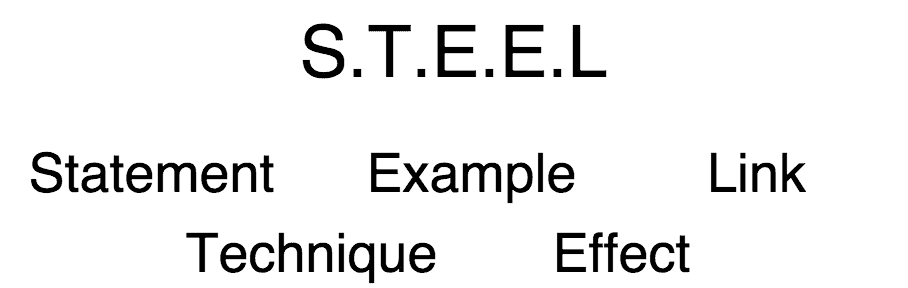
It’s similar toPETAL(point, example, technique, analysis, link) orPEEL(point, example, explain, link).
STEEL is a fantastic paragraph format that teaches you how to effectively structure and balance your body paragraphs so that you write the best paragraph you can.
It’s hard to take seriously when your teacher is just writing a bunch of letters on the board, but believe me, STEEL is a great tool to have.
By the time I got to the HSC I was using STEEL in every paragraph I wrote without even having to think about it, I just did it!
Of course this was great for essays because I was writing on point body paragraphs,but it was also really useful for short answer questions as well.
Plus, with a little tweaking you can actually apply STEEL to most subjects for essay writing, so it gives you a leg up there as well.
Q5. How many words can you write in 40 minutes?
Again, this varies.
I can write about 900 – 1,200 words in 40 minutes depending on how well I know my topic, how many practice essays I’ve written, how much sleep I’ve had and how heavy my pen is.
The fact of the matter is that time limits leave room for massive inequality, because people write at totally different paces and levels in HSC English, but there is no real way to amend this.
You really want to be aiming to write 1000 words in 45 minutes. That means about250 words every ten minutes, or25 words per minute.
It sounds like a lot, but considering the words you use most often are quite short (‘the’, ‘and’, ‘a’, etc.) it’s not actually that much of a stretch.
You just need to learn how fast you can currently write and start building yourself up to write faster, which is something you can only do with practice. I’ve seen people tape marbles to their pens as weight training.
For every essay you have to write under time limits I recommend doing at least 2 practice essays with the same time constraints.
It’ll teach you how to manage time and show you how fast you can write, so if you really can’t finish in time you can start cutting down, rather than just leaving a whole paragraph off the end of your essay.
Q6. Should I memorise or improvise my essay?
With the new HSC English syllabus, it’s become a lot harder to memorise your essays and expect yourself to be able to answer the question perfectly.
However, there are arguments for and against memorising or improvising your essay!
Pros of Memorising Your HSC Essay
- Confidence –having a planned response ready to go when you walk into the exam room is an instant confidence boost, because you already know what you’re going to write!
- Refining –because you have to rewrite your essay a few times in order to remember it, you’re able to spot problem areas and refine your response each time, leading to a much more sophisticated essay.
Cons of Memorising Your HSC Essay
- Adapting –it doesn’t matter how good your essay is if it doesn’t answer the question, and if the question on your exam paper is nothing like the one you prepared your essay for you’re in a major tight spot.
- Improvement –even if your prepared response suits the question, it often doesn’t fit perfectly, and many students don’t think to make small changes to their memorised essay in order to make it better answer the question.
You can read up on our full list of pros and cons for improvising or memorising an essayhere!
Q7. What are all the literary and visual techniques?
We have an awesome set of lists that cover both of these topics for HSC English!
Q8. How messy can my handwriting be?
One of my best friends in high school had handwriting that looked like a drunk chicken had stepped in ink and then walked across his page. He got away with it mostly, but when it came time for HSC year our teacher took one look at it and said there’s no way that would fly on his exams.
As much as I wish I could tell you to be as messy as you like, your handwritingmust be legibleif you want it to be marked.
That means if the markers can’t read it they won’t mark it,and with hundreds of essays to mark they’re not going to spend ages trying to figure out if that’s a ‘t’ or an ‘f’ you’ve written.
如果你知道你需要你的写作是非常混乱的to start trying to neaten it up and sort it out for the HSC.
The best way to know how messy is too messy is by giving a practice essay (written under time limits) to a friend to mark and have them circle any word they can’t read. If there’s more than 2-3 words per page, your writing is still too messy and you need to keep trying!
Sometimes it comes down to having the right tools too! My friend swears byLAMY AL-star Fine Nib Fountain Pento get her writing evenslightlylegible (Exhibit A, above), but you might prefer your good old Bic Biro.
Q9. How do I understand Shakespeare?
It doesn’t matter what anyone says, Shakespeare always has and always will confuse people — especially in HSC English! It’s a mix of the old English, metaphors and play format (unless you’re studying his Sonnets) but generally he’s just a very confusing read.
The best ways to understand Shakespeare isto get an idea of what’s happening overall before trying to understand the little bits.
I suggest watching the movie (which there are usually several of for each of his plays) and/or thoroughly reading through a summary onNo Fear Shakespeare (it’s part of sparknotes).
Once you actually know what the story is about and what you’re actually trying to understand it’s much easier to go through the text and know what’s happening.
If you’re still having trouble, keep referring back to websites likeNo Fear Shakespeare,which explain the plays in simple English alongside the actual script. Obviously don’t forego reading the play itself, as these websites will help but they can’t be used when you’re actually analysing the work, so you still need to read the original.
Maddison Leachcompleted her HSC in 2014, achieving an ATAR of 98.00 and Band 6 in all her subjects. Having tutored privately for two years before joining Art of Smart, she enjoys helping students through the academic and other aspects of school life, even though it sometimes makes her feel old. Maddison has had a passion for writing since her early teens, having had several short stories published before joining the world of blogging. She’s currently studying a Bachelor of Design at the University of Technology Sydney and spends most of her time trying not to get caught sketching people on trains.