
因此,USYD的音乐学士学位听起来像您最喜欢的东西,但是您想了解更多吗?
这份有用的指南将向您介绍核心学科,大学文化,职业道路以及您未来在Uni的生活的一天……等等!
Read on to learn more about studying USYD Music!
What is a Bachelor of Music at USYD?
Core Units and Specialisations
How to Get into a Bachelor of Music at USYD
What’s the Teaching Format?
What’s the Faculty and Culture Like?
What is a Bachelor of Music at USYD?
ABachelor of Musicis the overarching degree name for anyone enrolled in music at USYD, which is whollytaught at the prestigious Conservatorium of Music(as opposed to the USYD main campus). It offers a broad music education with经验的机会music and arts-related contexts.
What can you expect from studying a Bachelor of Music?
Studying a Bachelor of Music at USYD,you can expect to be educated by some of Australia’s leading performers, composers and musicians of contemporary acclaim. You will attend Australia’s leading institution for the undergraduate study of music, and beimmersed in a playful and collaborative learning environment with countless opportunities for industry experience and recognition.
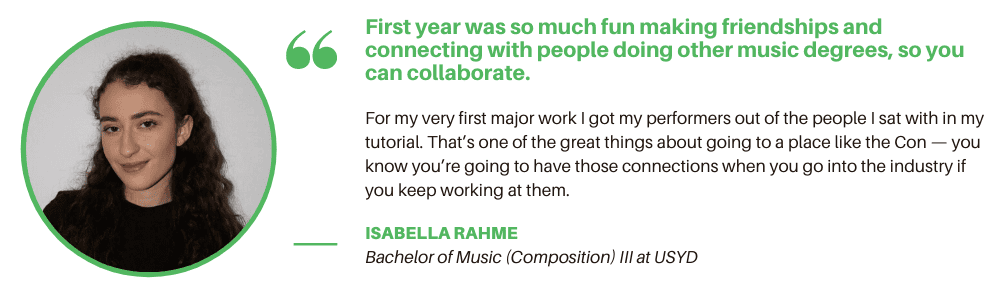
Theconnections you make at the Con with peers, teachers and guest professionalscan often become the springboards for your future opportunities and/or career.
You can also expect to be able totailor your degree to best fit your interests!
Career Paths
USYD的音乐学士学位prepares you for a variety of careers depending on your specialisation.Bachelor of Music students also may enter into interdisciplinary jobs that combine music knowledge with, for example, communication or management skills.
A list of common pathways for this degree can be found below:
-
- Arts administrator
- Composer
- Contemporary musician
- Digital music composer and performer
- Festival or venue manager
- 互动音乐设计师
- Music journalist
- Music producer
- 音乐研究员
- Singer/songwriter
Core Units and Specialisations
What are the Specialisations?
A Bachelor of Music allows you tospecialise in one of four main ‘programs’on offer:Contemporary Music,Composition for Creative Industries,Digital Music and Media, andMusicology,否则选择之一everal ‘streams’of the degree:
-
- Bachelor of Music (Composition)
- Bachelor of Music (Performance)
- Bachelor of Music (Music Education)
Please note thatstudents who choose to study a Bachelor of Music degree at USYD will choose one of the four programs after enrolment.
If they desire to study a stream however, they must choose that stream in the enrolment process itself(the stream is treated by UAC as a different degree from simply a ‘Bachelor of Music’). Studying a stream is highly popular among students at the Conservatorium!
What is expected of you?
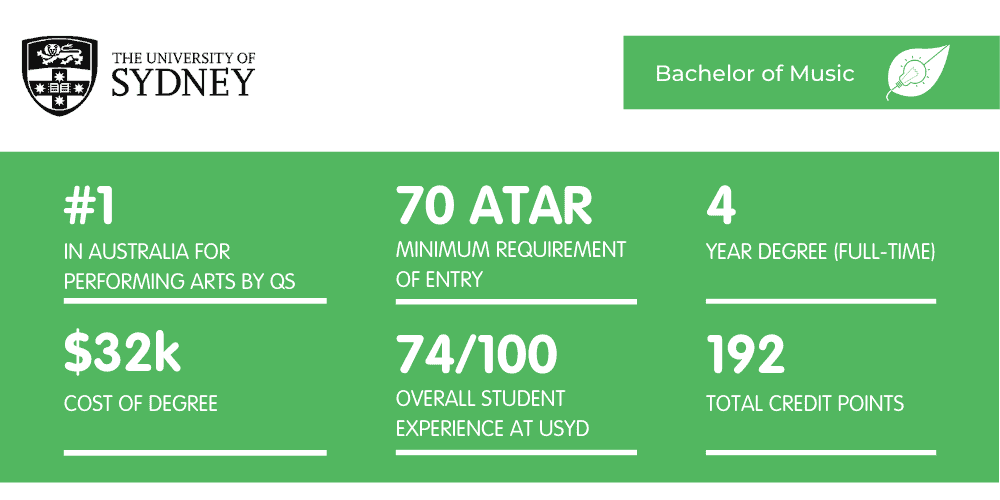
As previously stated,your experience of a Bachelor of Music at USYD will really depend on the specialisation you choose.However, all students studying a Bachelor of Music areexpected to study an equivalent of 48 credit points of core units; this goes up to 54 if you are thinking of doing a stream, due to the extra core requirements of that stream.
All music students are需要在“音乐技能”信用点以及“分析,文化和历史”单元中执行某些核心主题。
What are the Core Units?
The core subjects students studying a Bachelor of Music can choose to complete within ‘Music Skills’range from music theory and aural skills, to music technology and practical keyboard skills.Some of these includeAural Perception(levels 1-4),Harmony and Analysis(levels 1-4),Jazz Music Skills(levels 1-4), as well as less conventional music skills likeSound Recording Fundamentals(CMPN1014), orWriting Music for Moving Image(CMPN3635)。
Additionally, all students must complete the unitMCGY1030 This is Musicin first year, as a part of ‘Analysis, Culture and History’. This subject delves into the fundamental questions of what music is, and why and how it is made, as well as the significance of music to society in general.
Other subjects in Analysis Culture and History that students may choose from to complete their core requirements includeJazz1021爵士历史1,MCGY2611音乐中的音乐和浪漫时代的音乐,MUSC3641音乐,环境和气候变化,以及其他历史与社会学科.
Final Year Projects
You will also undertake12个学分的如果您决定不承担的话Honoursprogram. This is an exciting opportunity that provides a holistic experience of professional and creative musicianship.
这通常是在一年中散布的Music Specialist Creative Project unitin Semester 1 and 2. You will collaborate in small groups across musical disciplines in a project, potentially engaging inperforming, recording, distribution, ensemble management, leadership, composing, audience development, and further facets.
A full list of the core units and the specific streams/programs they relate to, as well as further details, can be foundhere.
Internships and Work Placement
The Sydney Conservatorium音乐也有a strong internship program that offers their students placements with many arts partners throughout NSW. While there is no in-built ‘work experience’ per-se in a Bachelor of Music at the University of Sydney, students studying this degree will beexposed to a range of industry level opportunities that can enhance their music understanding, connections and resume.
它享有声望的实习伙伴包括Sydney Symphony Orchestra,ABC Classics,Australian Brandenburg Orchestra,Australian Youth Orchestra,NIDA,Opera Australiaand theCity Recital Hall.
How to Get into a Bachelor of Music at USYD
AnATAR of 70is necessary for guaranteed entrance into a Bachelor of Music at USYD. Though, there are other ways to get in without an ATAR!
Admission Pathways
Domestic applicants undertaking a current recognised high school (Year 12) qualification and applying via UACmight be eligible for an early offer of admission before the release of ATARs(or an equivalent domestic score) under theUniversity’s Creative Arts Special Admission Scheme.These students will be assessed based on a combination of academic performance and试听要求.
Admission pathways are also always open to domestic students on the basis of certain adjustment factors. For more information, visitadmission pathways!
如果您已经完成了大学级或同等学科,则可以申请credit for previous study.
Assumed Knowledge and Prerequisite Subjects
If you’re planning on specialising in the Composition for Creative Industries program, thenHSC Music 1 or equivalent notation skillsis assumed knowledge for a Bachelor of Music.HSC音乐2或同等符号技能也是assumed for a Bachelor of Music (Composition), (Performance) and (Music Education),otherwise there are no other prerequisites/assumed knowledge.
If applicants fail to meet these requirements,theymaybe granted admission on the basis of having successfully undertaken tertiary studies in music at or above Diploma levelto the equivalent of at least one year of study.
Scholarships
The Sydney Conservatorium of Music offers a long list of scholarships for undergraduate students. These include those whichsupport the needs of low socio-economic background students, or Aboriginal and Torres Strait Islander students, as well as those specific to certain musical skills (e.g piano student, string student) and to women.
For a full list of these scholarships and their requirements, visit这里!
What’s the Teaching Format?
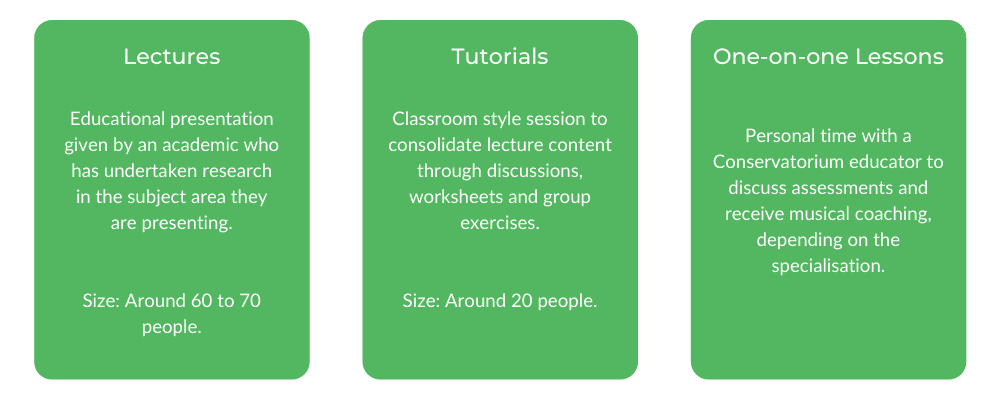
The University of Sydneyoperates on a semester basis, with 2 sessions per year, starting in March and September. For USYD Music, your classes will involve acombination of lectures, tutorials and one-on-one sessions(for students in streams).
Class Structure
讲座
Notably,lectures for students studying a Bachelor of Music are delivered by different guest lecturers weekly depending on the subject, who are always highly experienced and often well-known within their particular field. This feature is该学位独有,增加了每个讲座的质量和参与度。
You’ll find that lectures will generally have around60 to 70 studentsin attendance andrun for 2 hours.
Tutorials
Tutorial classes for music subjects typicallyconsist of many different activities, due to the variety of specialisations and units on offer.
Students can commonly expect topractice music skills such as listening exercises, notation, or other forms of written responsein their Music Skills units. This may also include讨论和审查讲座材料,或分享学生工作和弹跳想法for programs like ‘Composition for Creative Industries’ as well as the Composition Stream of the degree.
此外,学习数字音乐和媒体计划或选举数字音乐主题的学生将experienceworking in the Conservatorium sound studios in their tutorials, recording, editing and mixing.
There are typically20 students within each of your tutesand they will usuallygo for an hour.
一对一的教师
One-on-one lessons with tutors are specific to streams, and differ for each stream. For example,Composition stream students can expect to discuss their semesterly projects with their tutors, and gain guidance and recommendations, whilePerformance students will receive music coaching much like private instrument lessons.
You are allocated6-7 hours within a semesterfor one-on-one lessons.
How much time do you spend at uni?
Like with most degrees, in a Bachelor of Music you canexpect to spend 15 to 20 hours a week at uni.However, depending on your degree,this may add up to more depending on your commitments(e.g. a performance stream student may use up extra time to rehearse).
Assessments
All music students are expected to completeexaminations at the end of each semesterfor their shared core units in Music Skills and Analysis, History and Culture. These can range from10 minute exams to 2-3 hour periods, and usually consist of listening, reading and writing.
The assessments for different specialisations and electives in a Bachelor of Music will vary; subjects that arecomposition focused will typically require a portfolio submissionby the end of semester, while performance subjects may demand a recital at the end of semester. For those in the Performance stream, this consists ofall the pieces the student has been working on throughout the period, and can be a fun event to invite friends to!
Skills That You Develop
First Year
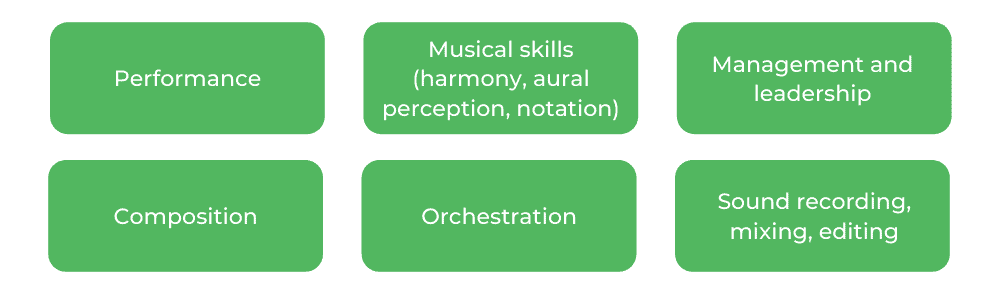
In your first year, you canexpect to develop your basicmusic literacy skills, including learning to read and write music, and an understanding of fundamental aspects of its structure and composition(MUSC1503 Fundamentals of Music 1). You will learnlistening skillsin MCGY1000 Aural Perception 1 and 2, involvingdictation and sight-singing exercises.
You will alsoextend your harmony and analysis skillsin Harmony and Analysis 1 to MCGY2011 Harmony and Analysis 2, includingmodulation, diatonic sequences and techniques for working with instrumental textures(please note that for certain programs and streams these skills are compulsory while for others they are not).
In addition, you will learn thefoundation skills of your specialisation(program or stream). For example, a student specialising in Digital Music and Media would learnsound recordingand editing techniques, including basic equipment and softwareinCMPN1014 Sound Recording Fundamentals (students outside of this program may also be required to complete a certain number of music technology or computer music units, particularly those studying Composition).
Similarly, a student specialising in Composition for Creative Industries, or doing the stream of Composition, would learn skills such asinstrumentation and orchestrationin CMPN1611.
Second and Third Year
In second and third year you may develop the skills learned in first, with subjects like Aural Perception 3 and 4, Harmony and Analysis 3 and 4 if you choose to. For those studying Composition for Creative Industries, expect to learnScoring and Arranging for the Screen, and Music Notation and Publishingin CMPN2510 and CMPN2320.
Similarly, programs like Digital Media and Music, Composition for Creative Industries, and the Composition stream may learn/be required to undertake learning in emergent skills such aselectro-acoustic music composition(CMPN2631) orInteractive Media and Sound Installations(CMPN3634).
Fourth Year
In their fourth year, students studying a Bachelor of Musicmay undertake an Honours program where they will learn how to choose an area of interest and develop a self-guided body of workor research.
Alternatively,students may engage in fourth year project units,其中他们将吸收专业音乐的技能,包括performing, recording, distribution, ensemble management, leadership, composing, and audience development.
What’s the Faculty and Culture Like?
教师和文化
Studying a Bachelor of Music at USYD meansentering a rich, creative environment full of innovative individuals working on different projects. This creative space is an excellent one for friendships, musical collaboration, and socialisation to thrive, as well as for seeking academic help throughout the course of your degree.
SUMS(Sydney University Music Society) — not to be confused with the Medical and Mathematics societies — isthe university’s undergraduate choir that you can join, however there are constant opportunities for engagement through choirs, orchestras and ensembles, and regular performances and showcases of student work.
The faculty is certainly a standout feature of studying a Bachelor of Music. In any stream,you can expect to be enriched by experienced lecturers well-known in their musical fields, with guest lecturers weekly including musicians likePaul Stanhope, Carl Vine, Daniel Blinkhorn, and Liza Lim.
Exchange Opportunities
Students considering a Bachelor of Music at USYD have theopportunity to travel abroad to over four continents(Asia, Oceania, Europe, North America) andstudy at their most prestigious music conservatories for up to a whole semester.A full list of the locations can be found这里!
Exchange isstrongly encouraged for Bachelor of Music students, allowing them toexperience music in a different culture并扩展他们的全球朋友网络。
Zara Zadrois a Content Writer for Art of Smart and a current undergraduate student at the University of Sydney. She studies a Bachelor of Arts/Advanced Studies majoring in Media & Communications and English. In her free time, she enjoys reading, listening to music and discovering new parts of Sydney. She has also written for the student publications Honi Soit and Vertigo. After she graduates, Zara hopes to do a Masters in creative writing and live overseas, which she cannot wait for!