
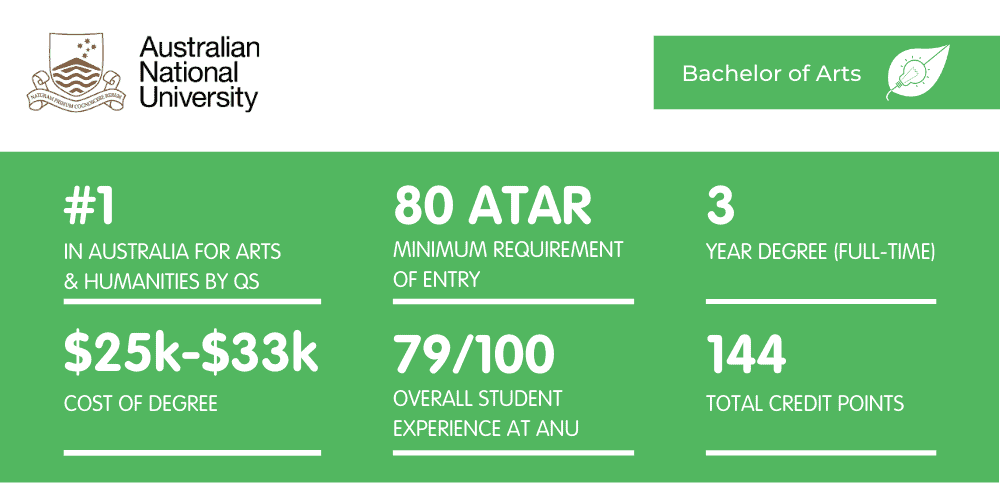
So you’re interested in a Bachelor of Arts at ANU, but want a taste of what it’s like?
This article will walk you through what anArts degreeconsists of, including core subjects, career paths, and teaching format, as well as an inside-perspective on university culture, life, and what to expect.
Let’s get right into it!
What is a Bachelor of Arts at ANU?
Core Units and Majors
How to Get into a Bachelor of Arts at ANU
What’s the Teaching Format?
What’s the Faculty and Culture Like?
What is a Bachelor of Arts at ANU?
ABachelor of Arts at ANUisa broad, flexible degree enabling you to focus a major of your choice from a pool of Arts majors the university offers. This degree is highly suitable for anyone who enjoyed humanities and/or arts subjects in high school, with majors ranging fromPolitical SciencetoArt History and TheorytoEnvironmental Studies.
What can you expect from studying a Bachelor of Arts?

Located in the Australian Capital Territory with connections to Parliament House, ANU and its Arts degree are特别是认为政治s, history, international relations, security, and various international studies coursesand faculties (e.g. Chinese studies, Pacific studies). ANU is particularly focused on global and current issues.
Additionally, expecta fairly rigorous academic demandif you’re considering studying a Bachelor of Arts at ANU, withemphasis on research and essay-writing. However, these are definitely demands of all arts degrees; and with passion and hard work, doing well is not too hard!
Career Paths
A Bachelor of Arts at ANU willopen you up to a great variety of career paths depending on the major you choose.Fields that graduates may later work in include:
- Publishing
- Policy
- Education
- International development
- Politics
- Media
- Information technology
- Communications
- Journalism
- Advertising
- Art conservation
- Government
和更多!
Check out more careers you can end up in with a Bachelor of Artshere!
Core Units and Majors
What are the Core Units?
As previously stated, a Bachelor of Arts at ANUprovides you with the flexibility to tailor your degree to a particular focus area, or several.In fact, double degrees and minors alongside majors are common amongst ANU Arts students.
Due to this,the core unit requirements are different between every arts course; however, each majorwillhave certain requirements!Usually, this involves meeting a certain number of credit points (i.e. a certain number of subjects) per semester for your major.
The Bachelor of Arts requires completion of 144 units, of which:
- A maximum of 60 units may come from completion of 1000-level courses
- A minimum of 84 units must come from completion of 2000- and 3000- level courses
This includes the necessary completion of 48 units fromone Arts major.
For example, an ANU student majoring inGender, Sexuality and Culturewould berequiredto complete two core first year subjects adding up to 12 credit points;GEND1001– Sex, Gender and Identity: An Introduction to Gender Studies(6 units) andGEND1002– Reading Popular Culture: An Introduction to Cultural Studies(6 units). As their degree progresses, they will be offered a larger pool of subjects to select from to meet a minimum requirement of credit points.
Evidently,students have space left over to either study a minor (a total of 24 credit points, or 4 subjects), a second major (48 units), or complete electives of their choice.Minors may include a language, or a geographically defined area of study (a full list of which can be foundhere).
Some of the standout elective courses that you may study in a Bachelor of Arts according to an ANU Arts student includeASIA 2026: The Politics of China, or理论啊f Social Justice, which applies philosophical frameworks to contemporary and past social justice action and movements such as protesting against Climate Change.
What are the Majors?
| Type of Major | Majors |
|---|---|
| Disciplines and Fields | Ancient History; Anthropology; Archaeology; Art History and Theory; Australian Indigenous Studies; Biological Anthropology; Criminology; Demography; Development Studies; Digital Humanities; Economic Studies; English; Environmental Studies; Gender, Sexuality and Culture; Geography; Global Security; History; Human Evolutionary Biology; Human Rights; International Communication; International Relations; Linguistics; Mathematics; Music; Music Technology; Peace and Conflict Studies; Philosophy; Political Science; Psychology; Screen Studies; Sociology; Technology, Networks and Society; War Studies. |
| Languages | Ancient Greek; Arabic; Chinese Language; French Language and Culture; German Language and Culture; Hindi Language; Indonesian Language; Italian Language and Culture; Japanese Language; Japanese Linguistics; Korean Language; Latin; Persian; Sanskrit Language; Spanish; Thai Language; Vietnamese Language. |
| Geographically Defined Areas of Study | Asian Studies; Asian History; Asia and Pacific Culture, Media and Gender; Chinese Studies; Contemporary Europe; India Studies; Indonesian Studies; Japanese Studies; Korean Studies; Latin American Studies; Middle Eastern and Central Asian Studies; Northeast Asian Studies; Pacific Studies; Southeast Asian Studies. |
Internships and Work Placement
ANU offers students of any discipline toundertakea significant research project within a workplace, typically in their third year.This is called theAustralian National Internships Program orANIP, and rewards academic credit to students’ degrees (in the place of, commonly, doing more electives to meet credit point requirements).
Of course,admission to this course is selectivedue to the high academic standards required to successfully complete it.
ANIP isa fantastic opportunity for real-world work experience and networking,particularly for students studying in political fields at ANU, who may have the chance to intern with a parliament MP!
How to Get into a Bachelor of Arts at ANU
TheATAR requirement for a Bachelor of Arts at ANU is 80, with no other prerequisite subjects or assumed knowledge.
Admission Pathways
Students who do not meet this requirement are able now to completeANU’sELIBS Diploma of Liberal Studies, a 1-year undergraduate degree that grants automatic entry to a Bachelor of Arts if successfully completed.
Students completing the Diploma with no more than one fail or incomplete grade and with a GPA of at least 5.0 out of 7.0 will receive 48 units of credit status when they progress into the Bachelor of Arts.
Find out more about this admission pathway and the requirements for ithere!
Scholarships
ANU offersa wide range of scholarships to assist domestic students with their study costs.These can be obtained on basis including academic merit, personal illness or disability, financial hardship, Indigenous heritage, refugee status, regional or remote location, and more.
For instance, you might be able to apply for theChanging Futures Scholarship, which offers $8000 per year.
For more information on scholarships, visit ANU’s pagehere!
What’s the Teaching Format?
ANU’s university calendar isdivided into two semesters, the first from late February to late May, and the second from late June to late October.
Class Structure
The class structure of a Bachelor of Arts at ANU typically comprisestutorials and lectures.
Lectures
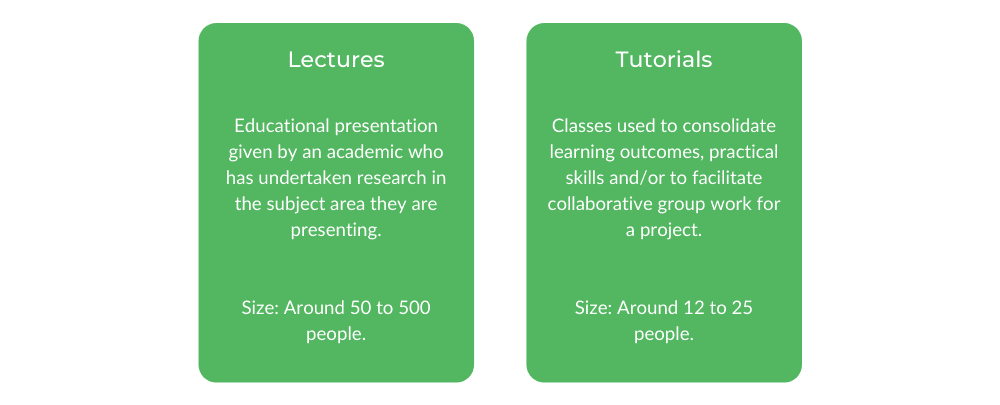
Lectures areinformative presentations to large groups(often online/via Zoom) about the key information of the subject.
Depending on the popularity of the subject area, a lecture in a Bachelor of Arts at ANU can comprise50 to 500 people.Lectures typicallyrun for two hours(or the equivalent) a week.
Tutorials
Tutorialsare usuallyinteractive, classroom-style sessions with around 12 to 25 people, where lecture material is consolidated and weekly topics are discussed with a tutor. Tutorials in a Bachelor of Arts may include practical activities depending on the subject, fromwriting blog posts to answering essay questions, to venturing outdoors to practice certain skills.
The main difference between tutorials at university and a school classroom is that universities oftenencourage a higher level of critical engagement with the texts or readings you’re studying, whether those be essays, books, images, or reports.A Bachelor of Arts at ANU encourages a high level of critical thinking in tutorials, as well as healthy debate.
How much time do you spend at uni?
Students studying a Bachelor of Arts at ANU will typically spend12-15 hours a week at university in class or lectures.However, spending more time on campus is common at ANU as many students are not from the local area, and may live on campus and choose to study or socialise there in their free time.
Assessments
If you don’t enjoy essay writing, you may want to reconsider studying a Bachelor of Arts! However if you do, at least in an area you’re passionate about, you’ll be pleased to know thatessays are a primary mode of assessment in this course.
That’s not to say there isn’t any variety;blog posts, group presentations and online quizzesare all common modes of assessment if you’re studying a Bachelor of Arts at ANU.
Some arts major subjects, such as Psychology and Political Science, may also haveend-of-semester examinations.如果这个问题你,一定要研究主要r you are planning to do by clicking through its core required subjects and checking whether or not it has exams!
Skills that You Develop
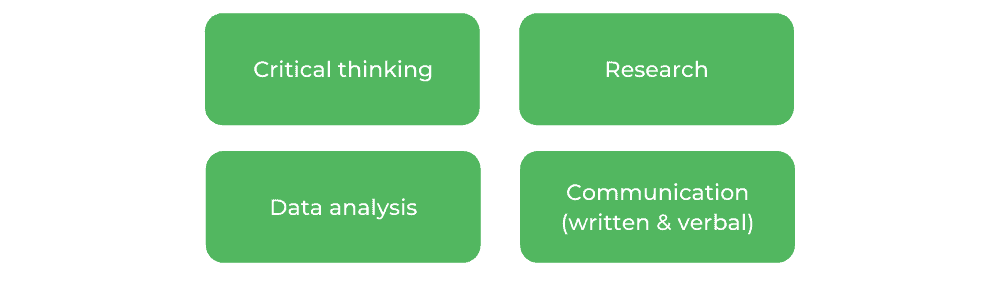
Every Arts degree major will imbue its students with varying knowledge, however a Bachelor of Arts at ANU fosters the following overarching skills in its graduates:
- Critical thinking
- Research skills
- Data analysis
- Communication skills (written, verbal)
The nature of ANU means it hasspecific ‘colleges’, or faculties, in comparison to other universities for its International and Political areas of study, such as the colleges of Chinese, Arabic, or National Security. Thus, theskills that graduates of these particular areas, within or overlapping with a Bachelor of Arts, may be more well-definedthan at other universities.
Additionally, a Bachelor of Arts at ANU (and most universities)allows you to try out a range of different electives,meaning students naturally gain skills in a broad range of areas no matter what their major is.
What’s the Faculty and Culture Like?
Faculty and Culture
The faculty and culture of a BA at ANU really depends on your area of study, howeverstudying within a community of people with similar interests is a positive and enriching experience across the board. Although ANU’s Bachelor of Arts certainly hosts an ambitious and often competitive student body as a high-ranking university, there are alsomany societies and activities that students can get involved in in their free time, such as its Arts Review and the student magazineWoroni.
However, society-life can often be a little less vibrant than college life at ANU due to the sheer amount of students who live on-campus from elsewhere.
Exchange Opportunities
ANU offers exchange to students who have completed 48 credit points of study, or roughly a year, at a variety of top universities and locations around the world in Asia, Europe, the Americas and Oceania. For a full list of these, you can check out their exchange pagehere.
Certain courses in a Bachelor of Arts may offerspecialised overseas study programs.
For example, Arts students majoring in Environmental Studies have the opportunity to partake in overseas field trips to locations like Fiji, Vietnam and Myanmar and learn aboutsustainable development, tourism, extreme weather management, and the effects of climate change in the real world(usually in the Pacific, where ANU has stronger ties). This typically occurs in third year.
Student Support
的学生的支持,阿奴an excellent platform of older student mentors and tutors to enhance students’ academic skills, including researching and writing, called‘The Academic Skills’. It is also recommended that future students consult with the College of Arts and Social Science if they need help planning their degrees eitherin person or via email.
Keen to learn about the pros and cons of this degree? Check out our articlehere!
Zara Zadrois a Content Writer for Art of Smart and a current undergraduate student at the University of Sydney. She studies a Bachelor of Arts/Advanced Studies majoring in Media & Communications and English. In her free time, she enjoys reading, listening to music and discovering new parts of Sydney. She has also written for the student publications Honi Soit and Vertigo. After she graduates, Zara hopes to do a Masters in creative writing and live overseas, which she cannot wait for!